

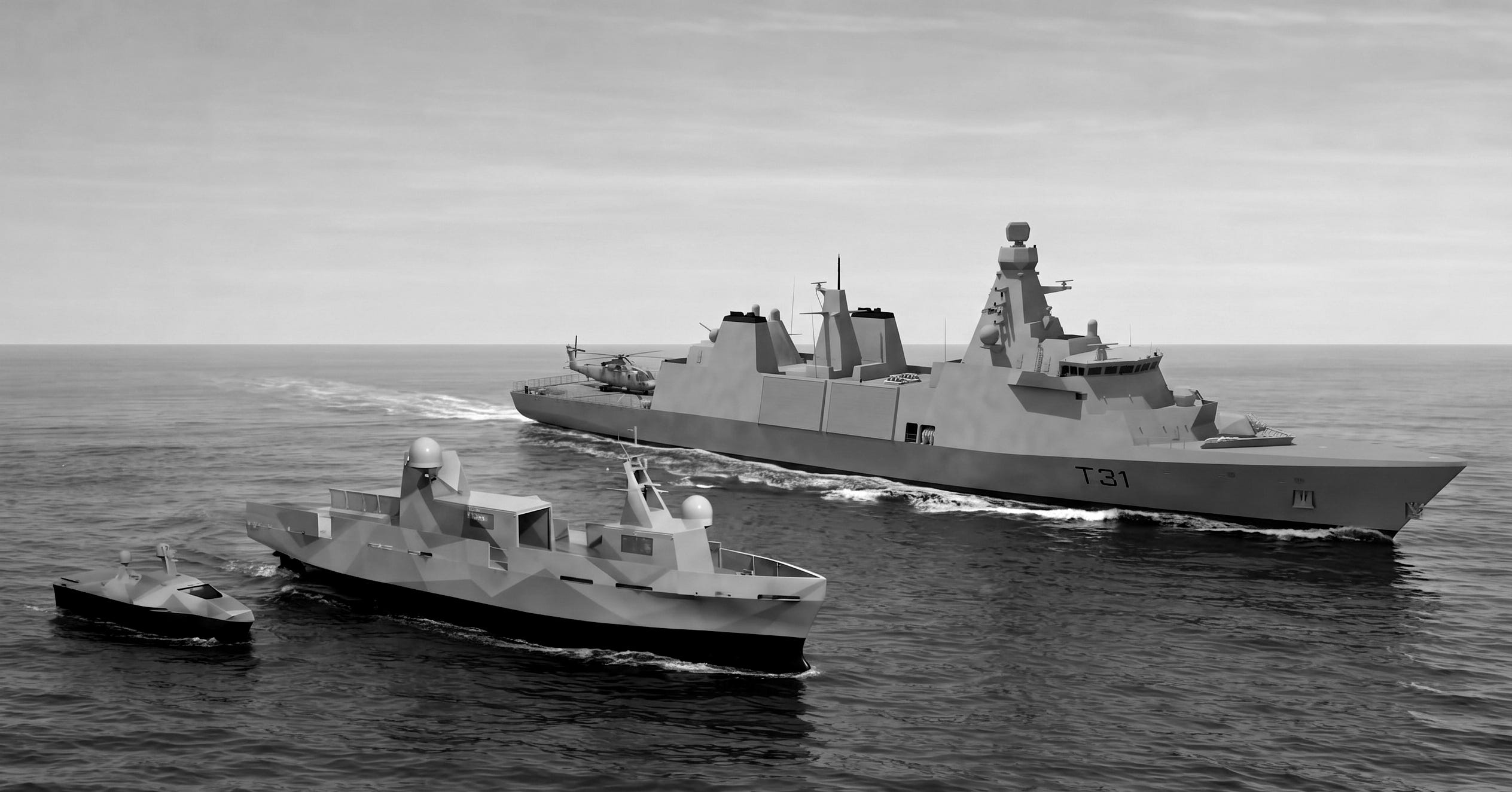
The Hybrid Navy is steadily moving from concept to reality.
Across the world’s leading navies, autonomous surface vessels, un-crewed underwater systems and AI-enabled command and control are growing essential to future force design. Much of the discussion quite rightly focuses on what these systems can do: extending surveillance, raising operational mass, reducing risk to sailors and providing commanders with new options across the battle-space.
Yet one question receives remarkably little attention.
What happens when the mission ends?
Autonomy does not eliminate support. It redistributes it. The future effectiveness of the Hybrid Navy will depend not only on capable autonomous platforms but also on the engineering, logistics, digital infrastructure, and people that sustain them.
The last mile of autonomy is not at sea. It begins when the autonomous system reconnects with the wider naval enterprise.
Beyond the Myth of the Crewless Ship
There is a persistent assumption that removing the crew removes much of the complexity.
Fewer sailors.
Lower costs.
Simpler operations.
Reality is rather different.
Removing sailors from the vessel does not remove sailors from the Navy.
Someone still plans the mission.
Someone remains accountable for command decisions.
Someone certifies software updates, validates sensor performance, repairs battle damage, analyses mission data, and authorises the next deployment. Autonomy changes where people add value; it does not eliminate their need.
The Mother Ship Remains Central
Much public discussion imagines autonomous vessels roaming independently across the world’s oceans. Current naval thinking points towards something more practical.
The Hybrid Navy is likely to centre on crewed warships acting as command nodes, deploying autonomous systems to extend reach rather than replace the parent platform. The mother ship becomes the first line of sustainment.
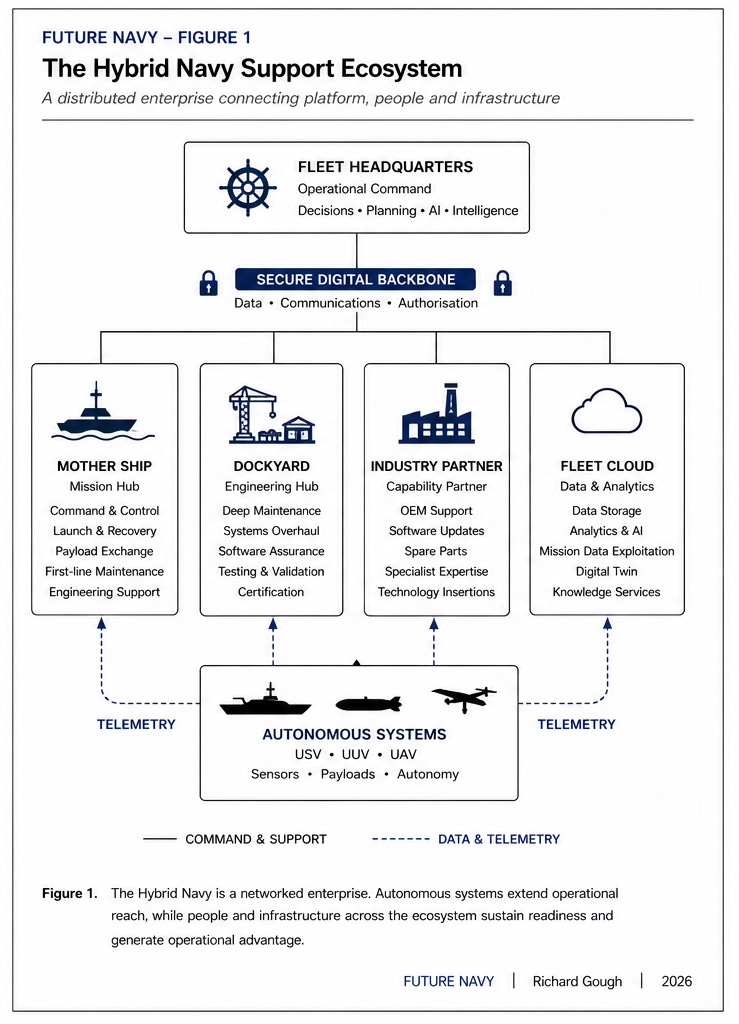
Whether a frigate, support ship or future autonomous mothership, it provides capabilities that autonomous craft cannot easily provide for themselves:
command and control
mission planning
secure communications
launch and recovery
payload exchange
first-line maintenance
engineering support
human judgement when autonomy reaches its limits
Rather than making crewed warships less relevant, autonomy arguably makes them more important. The centre of gravity shifts from individual platforms to connected systems.
The Real Last Mile
Eventually every autonomous vessel returns. Perhaps not to Portsmouth after every patrol but certainly back into its support ecosystem. This is where the invisible work begins. Unlike conventional patrol craft, much of the engineering effort goes beyond mechanical systems.
Between missions, the vessel may require:
software assurance
AI model validation
cyber integrity checks
battery replacement or charging
payload reconfiguration
sensor recalibration
predictive maintenance
communications testing
mission data exploitation
hull inspection
Operational preparedness depends less on repairing failures and more on preventing them. The support organisation becomes as important as the platform itself.
Ports Become Digital Operations Centres
Ports have traditionally been viewed as places where ships refuel, rearm and undergo maintenance. The Hybrid Navy changes that role, future naval bases become digital operations centres.
Long before an autonomous vessel reaches harbour, its engineering health may already be known.
Telemetry has identified emerging faults.
Replacement parts have been allocated.
Software patches prepared.
Payloads configured.
Engineers assigned.
The physical turnaround is the final stage of a process that started while the vessel was still hundreds of miles away. Ports evolve from maintenance facilities into highly connected engineering hubs where physical infrastructure and digital infrastructure become inseparable.
Lessons from Formula One
Perhaps an unexpected comparison can be found in Formula One.
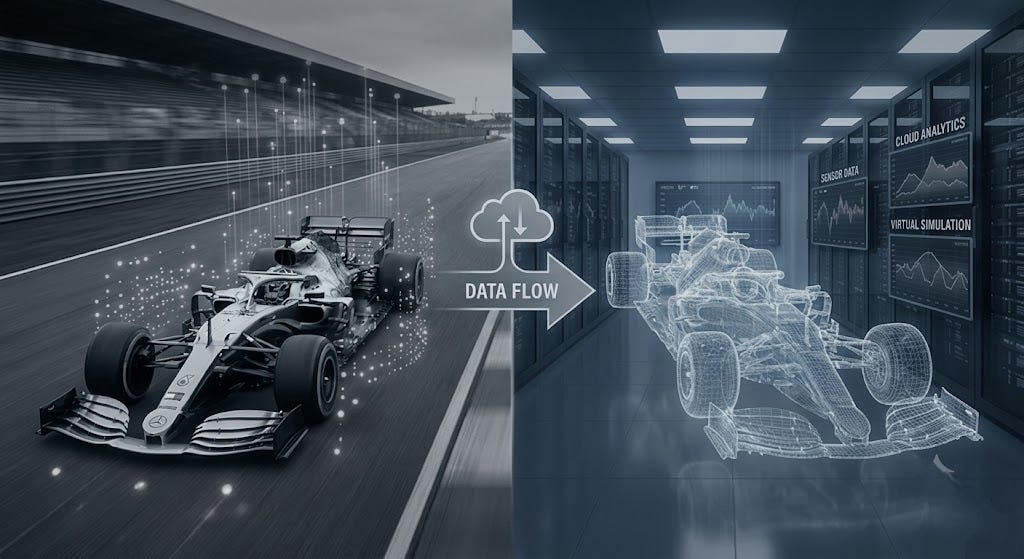
Championships are no longer won solely by the fastest driver or most powerful engine. Success depends on how effectively teams exploit data. Thousands of telemetry points stream continuously from each car.
Engineers track performance in real time.
Remote operations centres support the race team from hundreds or even thousands of miles away.
Different specialists receive different views of exactly the same information, enabling decisions that improve performance while reducing risk.
The Hybrid Navy faces a remarkably similar challenge.
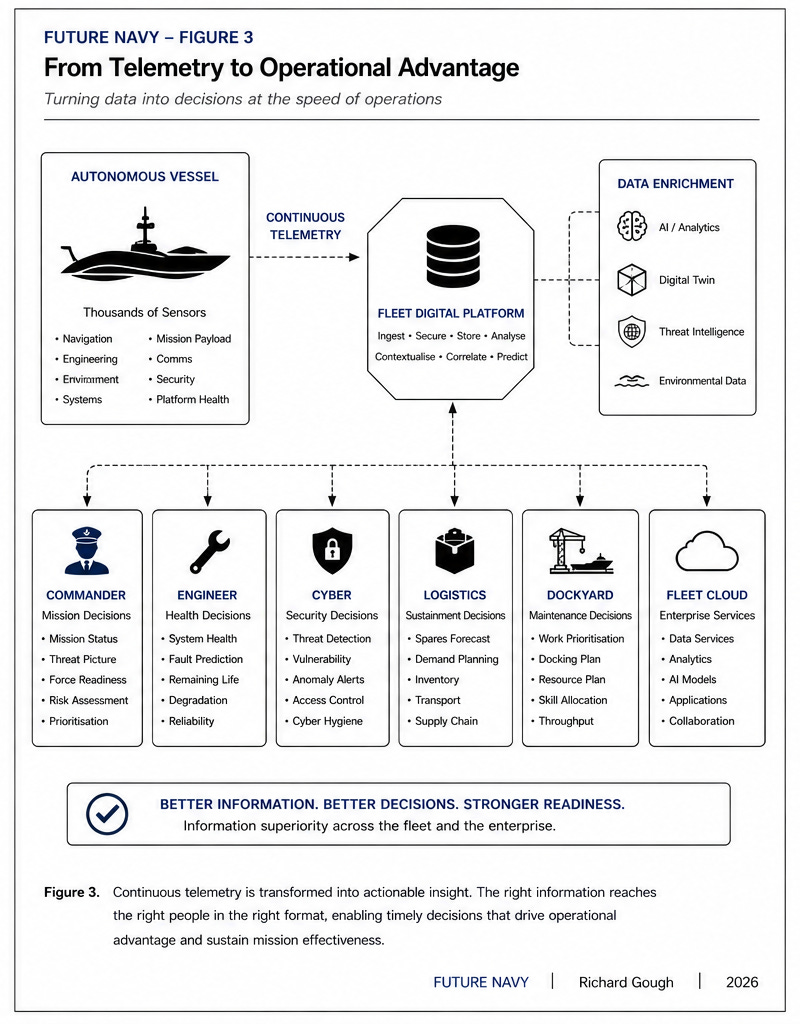
Autonomous vessels will generate enormous quantities of engineering, navigational and operational data. The challenge is not collecting it. Modern sensors make that relatively straightforward.
The challenge involves ensuring that the right information gets to the right people, in the right format, at the right moment.
The commanding officer requires mission readiness.
Engineers require equipment health.
Cyber specialists require security status.
Logisticians require forecasts of future demand.
Dockyards require maintenance schedules.
The value is not in the volume of data, but in changing that data into operational decisions.
A Different Kind of Workforce
Much of the argument surrounding autonomy focuses on reducing manpower. A more interesting question is how manpower changes.
Tomorrow’s naval support organisation may increasingly rely on robotics engineers, software specialists, AI assurance teams, cyber professionals, and data analysts working alongside experienced sailors.
The engineering branch itself evolves. Instead of waiting for equipment to fail, engineers increasingly monitor condition, predict degradation and intervene before faults become operational failures. Technology changes the nature of expertise; it does not replace expertise.
A Personal Reflection
One reason this subject specifically interests me is that I have seen a similar transformation outside defence.
As a Chief Technology Officer, I was responsible for the health and security of large-scale digital infrastructure. Like a modern Formula One team, we relied on continuous telemetry from thousands of endpoints, predictive monitoring, and real-time security analytics. AI wasn’t making operational decisions but was spotting anomalies, predicting failures, and delivering the right information to the right specialist at the right time.
Over time, I trusted AI to monitor complex systems more consistently than manual processes. The human role didn’t disappear; it evolved. Engineers spent less time watching dashboards and more time interpreting information, making decisions, and solving problems requiring experience and judgement.
I believe the Hybrid Navy faces a comparable transition. Autonomous vessels will generate vast quantities of engineering and operational data. Success will depend not on collecting that data, but on turning it into timely decisions across the mother ship, the dockyard and the wider support enterprise.
The lesson is not that navies should become Formula One teams or enterprise IT departments. Rather, both demonstrate that competitive advantage increasingly comes from connecting people, platforms and data into a single operational system. The vessel may be autonomous, but the support network behind it remains truly human.
Conclusion
It is easy to be fascinated by autonomous technology. It is harder—but ultimately more important—to think about what happens after the mission.
Every autonomous vessel still depends upon people. Not necessarily onboard, but throughout a network of operators, engineers, logisticians, software specialists and commanders who keep the system functioning. The Hybrid Navy will not succeed simply by acquiring autonomous vessels. It will succeed because it learns how to sustain them.
That entails investing not only in ships, but in mother ships. Not only in sensors, but in digital infrastructure. Not only in artificial intelligence, but in the engineers and sailors who know when to trust it, when to question it and ultimately how to turn information into operational advantage.
The future may indeed belong to autonomous systems. But the last mile of autonomy will always remain intrinsically human.
Further Future Navy Reading
Hybrid Navy: Autonomous VLS Engineering
Naval Readiness and the Software-Defined Warship
·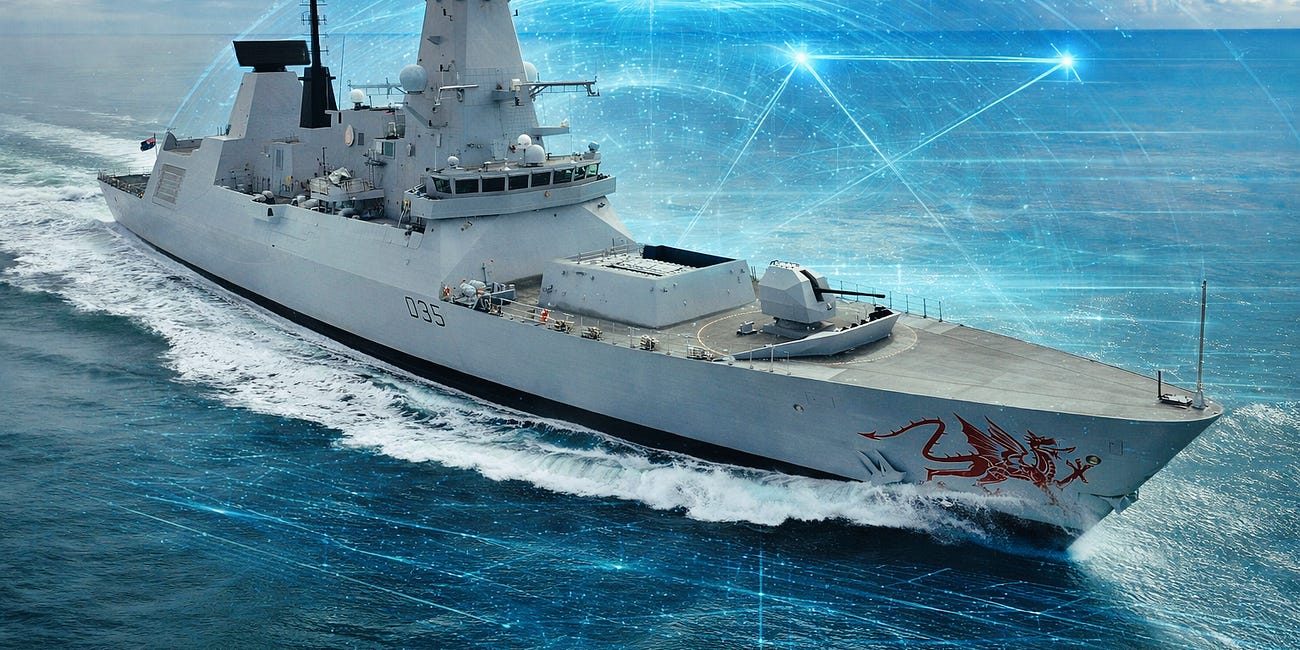
When HMS Dragon was rapidly deployed to the Eastern Mediterranean in March 2026 after drone strikes near RAF Akrotiri, debate focused on Royal Navy readiness. Yet, this event illustrates a fundamental shift in what readiness means for a modern navy.
External Links
