

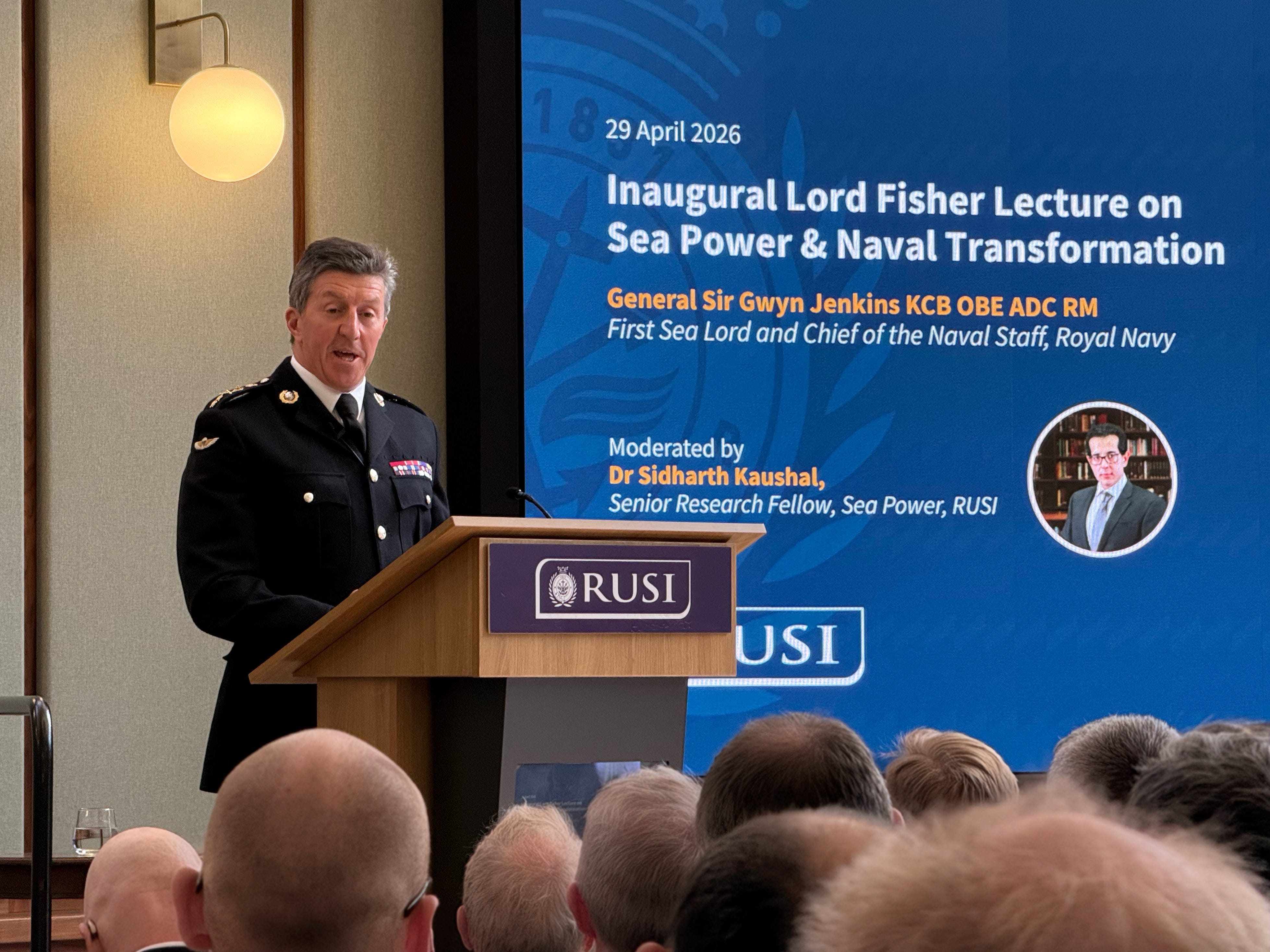
Future Navy attended the inaugural Lord Fisher Lecture on Sea Power & Naval Transformation given by the First Sea Lord. There are moments when a speech is more than a speech. It becomes a signal.
General Gwyn Jenkins KCB OBE ADC RM, set out a vision for the Royal Navy that is both familiar and deeply uncomfortable. Familiar because it echoes the long arc of naval transformation, yet uncomfortable due to the unprecedented pace, risk, and scale of change now being demanded, which connects past reform to today’s urgent challenges.
This is not incremental reform. It is an attempt to reset how the Royal Navy fights, marking a clear departure from previous incremental reforms and setting the stage for a more dramatic transformation.
A Fisher Moment—But With Less Time
The invocation of John Fisher was deliberate.

Fisher understood that naval power was not just about ships. It was about industrial capacity, technology, and the willingness to discard what no longer worked. He forced change through the system, often brutally.
The First Sea Lord is signalling something similar:
Ruthless prioritisation
Acceptance of risk
A willingness to move faster than the system is comfortable with
But there is one critical difference between now and Fisher’s time that shapes the scale of the task today. Fisher had time.
The Royal Navy does not.
The Hybrid Navy: Not Replacement, But Reinvention
At the heart of the speech sits the idea of a Hybrid Navy, a concept that builds on the themes of change and urgency established earlier.
This is not about replacing warships with drones.
It is about changing how combat power is generated:
Crewed platforms remain the backbone.
Uncrewed systems provide mass, persistence, and reach
AI-enabled systems compress decision timelines.
This aligns closely with what we are now seeing in Ukraine and the Middle East:
Low-cost systems are shifting the balance.
High-end platforms are increasingly exposed.
Scale is becoming as important as sophistication.
The direction is sound. But executing this vision—which is grounded in both historical reflection and current realities—will be immensely challenging.
Atlantic Bastion: The Real Centre of Gravity
Beneath the broader narrative, one element stands out.
The North Atlantic.
The speech reinforces what has been building for over a year: Atlantic Bastion is becoming the organising concept for Royal Navy warfighting.
A layered system of:
Crewed ASW platforms
Uncrewed surface and subsurface systems
Persistent sensor networks
Integrated data and targeting
The aim is simple:
Detect, track, and constrain Russian submarine activity before it matters.
This reflects the reality that undersea warfare remains the most consequential domain of conflict.
It also reflects a hard truth:
The UK cannot match mass with traditional platforms.
It must build persistent awareness instead.
As RUSI analysis has highlighted, Bastion is fundamentally about integrating low-cost autonomous systems with high-end assets like the Type 26 to create a scalable ASW network. The concept is credible. But it is not yet complete.
Atlantic Bastion: Europe’s New Front Line

Most people probably missed it. Buried under election noise, competing global crises, and the usual transatlantic commentary, the United States published its new National Security Strategy (NSS), which marks the most consequential shift in American defence posture in over a decade.
Speed as Strategy
Perhaps the most striking part of the lecture was not the technology, but the language of time.
“We measure technological advancement in days, weeks and months, not years.”
This is a rejection of traditional defence procurement culture.
It reflects a shift toward:
Rapid iteration
Prototype deployment
Learning through use
This is consistent with the emerging concept of “prototype warfare”, where capability is developed through continuous operational feedback rather than long acquisition cycles.
It is also where the real friction will occur. Because speed is not just a technical challenge. It is an institutional one.
The 2029 Problem
The First Sea Lord has set a clear ambition:
A warfighting-ready hybrid fleet by 2029.
This includes:
Uncrewed escort vessels within two years
Carrier-launched drones in the near term
Integrated hybrid operations across the fleet
It is an ambitious timeline.
Possibly too ambitious.
Not because the technology cannot be delivered. But because integration, training, and doctrine take longer than platforms.
The risk is not failure. The risk is partial success:
Systems delivered
Concepts unproven
Operators unconvinced
There is a real risk the Royal Navy fields systems faster than it learns how to fight them. And in war, that gap matters.
Command in the Age of Machines
One line in the speech deserves more attention than it will likely receive: “Modern warfare does not account for the chain of command.” This point bridges the rapid technological and operational changes to their inevitable impact on decision-making structures.
This is the real transformation.
Not drones.
Not autonomy.
But decision-making under compression.
If systems operate at machine speed:
Authority must be delegated.
Trust must be redefined.
Human judgment must shift from control to oversight.
This is where the Hybrid Navy becomes more than a force structure change.
It becomes a command culture change.
And this is the hardest transformation of all.
Allies, Integration, and Reality
The proposal for a Northern European maritime force, building on frameworks like JEF, is strategically sound.
Interoperability, shared logistics, and common systems offer:
Greater mass
Faster response
Stronger deterrence
But this is not simply a technical problem.
It is political.
Sovereignty concerns
Differing threat perceptions
National command constraints
Integration at this level is difficult in peacetime.
It becomes harder under pressure.
Where This Leaves the Royal Navy
This speech does not answer every question.
But it does clarify intent and highlights what the Royal Navy must achieve to remain effective: prioritising the North Atlantic, fully integrating new technologies, and adapting its command culture at speed.
The Royal Navy is:
Prioritising the North Atlantic
Embracing uncrewed and autonomous systems
Attempting to move at a speed it has historically resisted.
It is also accepting something more fundamental:
The current model of naval power is no longer sufficient.
Final Thought
The Royal Navy is not trying to build a slightly better fleet. It is trying to build a different one, fast enough to matter.
Whether it succeeds will depend less on the technology it acquires, and far more on the Royal Navy’s ability to change how it thinks, trains, and fights—directly linking its future effectiveness to the cultural transformations discussed throughout the speech. Because in the end, the challenge is not building the hybrid fleet.
It is learning how to command it.
Further Reading
RUSI – The Atlantic Bastion: Deterrent Design and ASW Futures
RUSI – Prototype Warfare in the Maritime Domain
Future Navy – The Digital Ocean: Securing the Invisible Fleet
The Digital Ocean: Securing the Invisible Fleet
·
The Royal Navy’s digital transformation is progressing steadily and significantly. What started as an engineering initiative to streamline shipboard computing has transformed into a comprehensive architecture for modern warfare. The Shared Infrastructure environment now serves as the foundation for over thirty combat systems, navigation, sensors, and we…
Future Navy – TEWA in the AI Age

