

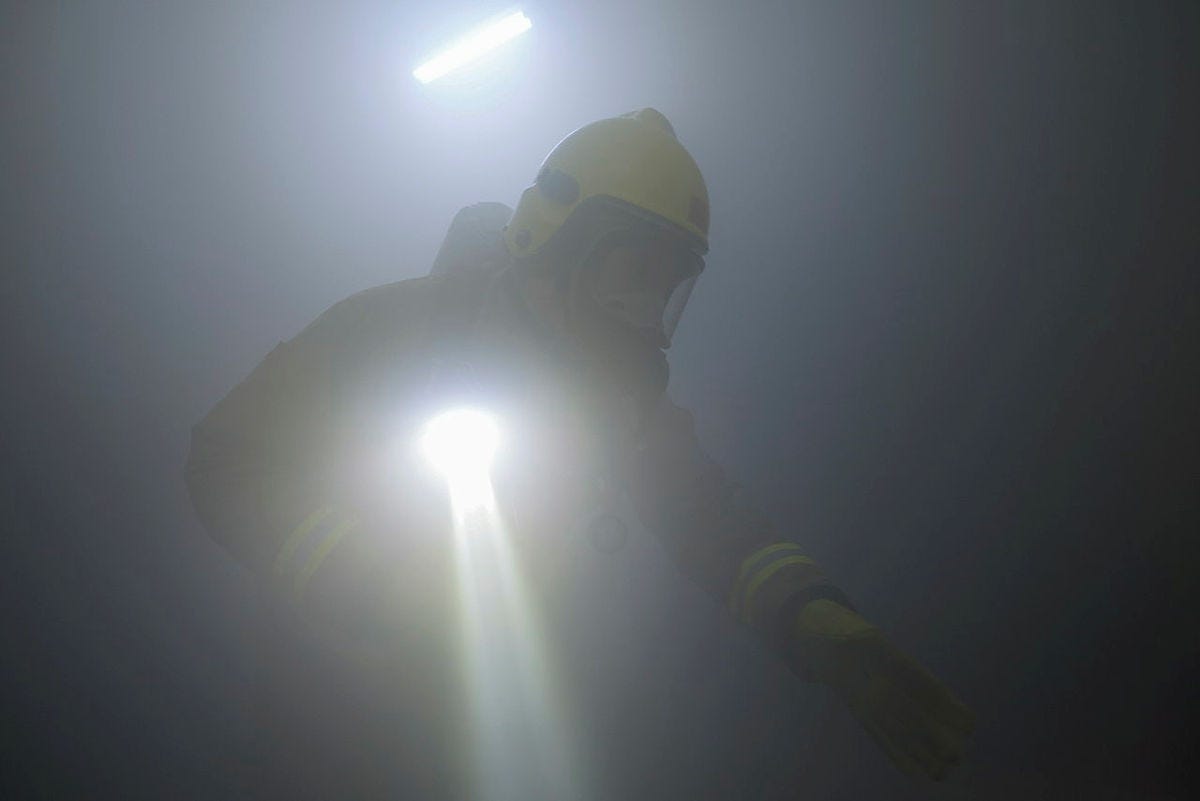
At the core of modern warship design is a simple question: how many sailors does a ship actually need? For years, the trend has been obvious. Automation has cut down crew sizes. Machines now handle tasks that once needed watch keepers. Sensors check equipment that used to be inspected by hand. More advanced software has taken over jobs that teams of sailors used to do.
The Royal Navy’s new Hybrid Navy pushes this idea even further. The goal isn’t just to run crewed warships more efficiently, but to mix them with remote-controlled and autonomous systems, spreading sensors, weapons, and other roles across a bigger fleet.
This approach makes sense. The Royal Navy needs more ships without needing a lot more people. Uncrewed systems can stay on task longer, cover more area with sensors, carry equipment, and handle jobs that would otherwise tie up valuable crewed ships.
But this question might miss something important. We often ask how many sailors it takes to run a warship. In wartime, though, the real question is different.
How many sailors does a warship need when things go wrong?
The Falklands Test
The Falklands conflict of 1982 was one of the first major tests of modern maritime warfare.
Anti-ship missiles, computer-assisted command systems, jet aircraft, nuclear submarines, electronic warfare and increasingly sophisticated sensors all played significant roles. The Royal Navy went south with ships and weapons designed primarily for a different Cold War battle in the North Atlantic and discovered, under fire, what worked and what did not.
But the campaign demonstrated something else. Modern naval warfare remained extraordinarily dependent upon people. Operation Corporate stretched approximately 8,000 miles from Britain to the South Atlantic. Ascension Island became the critical forward node. The Royal Fleet Auxiliary provided the replenishment lifeline, while merchant shipping was rapidly requisitioned and converted to carry troops, aircraft, fuel and stores.
Merchant ships transported thousands of personnel and enormous quantities of freight south. The fuel chain moved hundreds of thousands of tons. The RFA conducted more than a thousand replenishments during the campaign. It was an extraordinary demonstration of logistics and improvisation, and people made it happen.
Engineers modified ships. Dockyard workers prepared vessels at extraordinary speed. Merchant seafarers sailed into a war zone. RFA crews maintained the supply chain. Sailors moved ammunition and stores. Maintainers kept equipment running thousands of miles from normal support facilities.
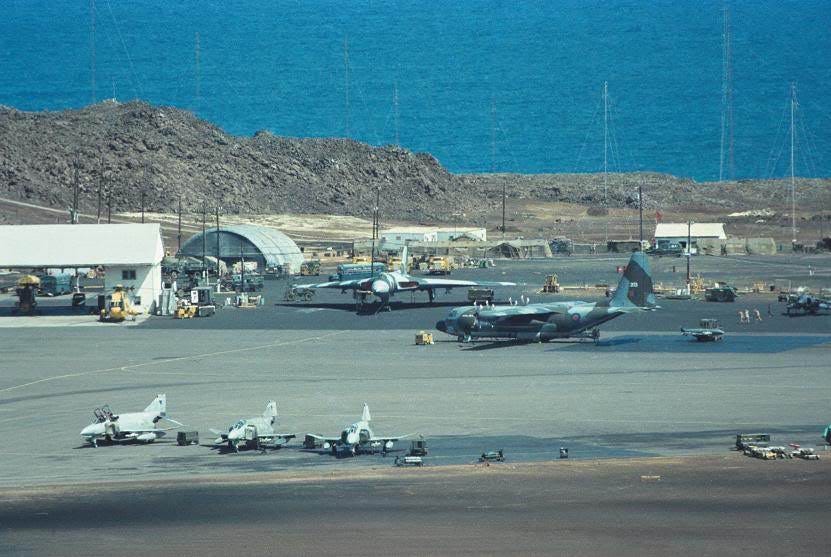
At Ascension, a logistics organisation that barely existed at the beginning of the operation expanded rapidly to support a fleet heading into combat. The system succeeded not because everything went as planned, but because people adapted when things didn’t.
When the Plan Meets the Enemy
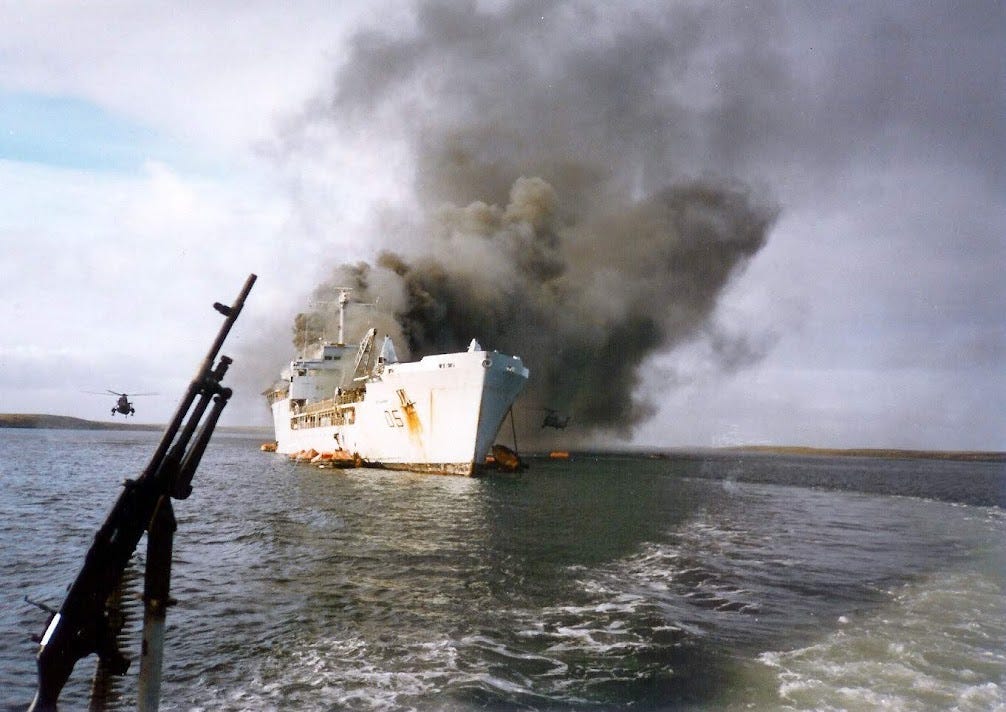
The loss of Atlantic Conveyor provides one of the clearest examples. She carried helicopters, stores and equipment essential to the land campaign. When Exocet missiles struck her on 25 May, three of the four Chinook heavy-lift helicopters being transported south were lost. Plans that had assumed significant helicopter mobility suddenly had to change.
Waterborne logistics, landing craft, smaller helicopters and human endurance filled some of the gap. The campaign continued. But Atlantic Conveyor revealed another important distinction. A merchant ship could be adapted remarkably quickly to carry military capability, but that did not automatically make it a warship. Her commercial construction complicated damage control. Her commercial construction offered less subdivision and damage-control resilience than a purpose-built warship, which made responding to the fire harder.
The lesson was not simply that warships should be better protected. It showed that survivability depends on design, equipment, training, and people working together. If one part is missing or weak, the others have to make up for it.
A Lesson From HMS Ardent
I experienced another part of that equation personally. By the time HMS Ardent reached the Falklands, we were running defence watches: six hours on, six hours off. As the air threat increased, the strain did too.
Long stretches of warfare aren’t exciting all the time. Often, they’re repetitive, uncomfortable, and exhausting.
You watch. You listen. You wait.
And tired people make mistakes.
Before the landings, I accidentally fired an anti-missile chaff rocket during routine system checks. No enemy aircraft were attacking us at the time. There was no equipment failure. I was simply tired.
The response aboard Ardent was revealing. I was not disciplined. The problem was recognised for what it was, and the procedure changed so that someone else oversaw my routine checks as well as all other operators. A small incident, but an important lesson.
How long people can keep going shapes how long the combat system can last.
Days later, on 21 May 1982, Ardent was subjected to repeated air attacks in Falkland Sound. Once a warship starts taking serious damage, the neat distinction between the people who operate the ship and those who save it begins to disappear.
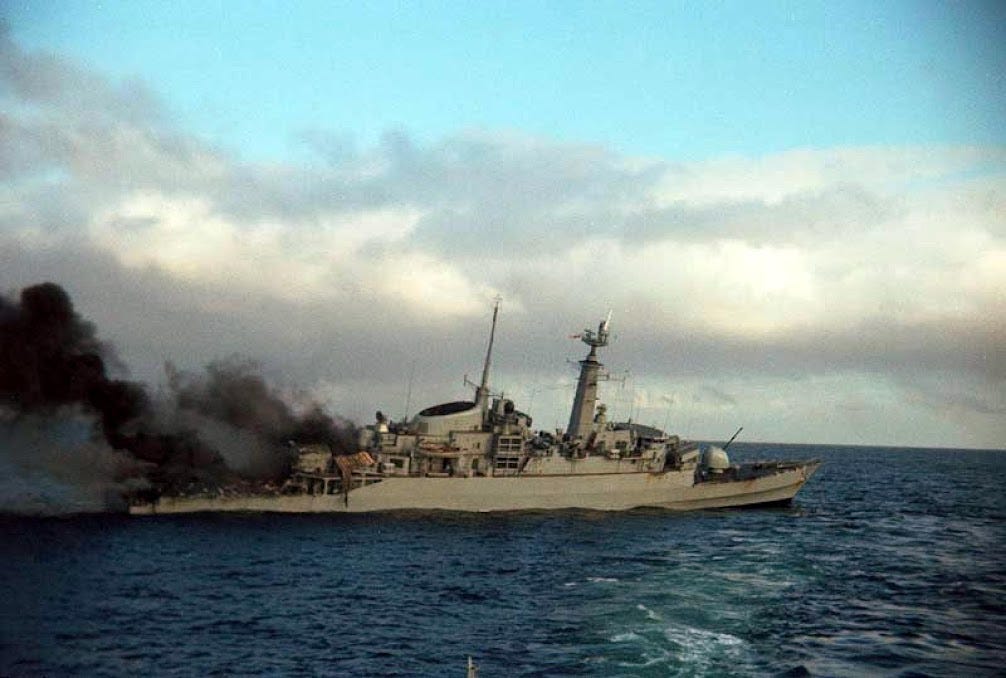
Fire, flooding, smoke, injuries, and broken systems create challenges that no peacetime plan can fully predict. In these moments, people become the redundancy.
Forty-Four Years Later
That lesson has renewed relevance.
The recent experience of the US Navy aircraft carrier USS Abraham Lincoln, after more than eight months deployed and more than 200 consecutive days without a port call, has again raised questions about human endurance at sea. Reports of problems with living conditions, supply, morale and sailor wellbeing have been disputed in part by the US administration.
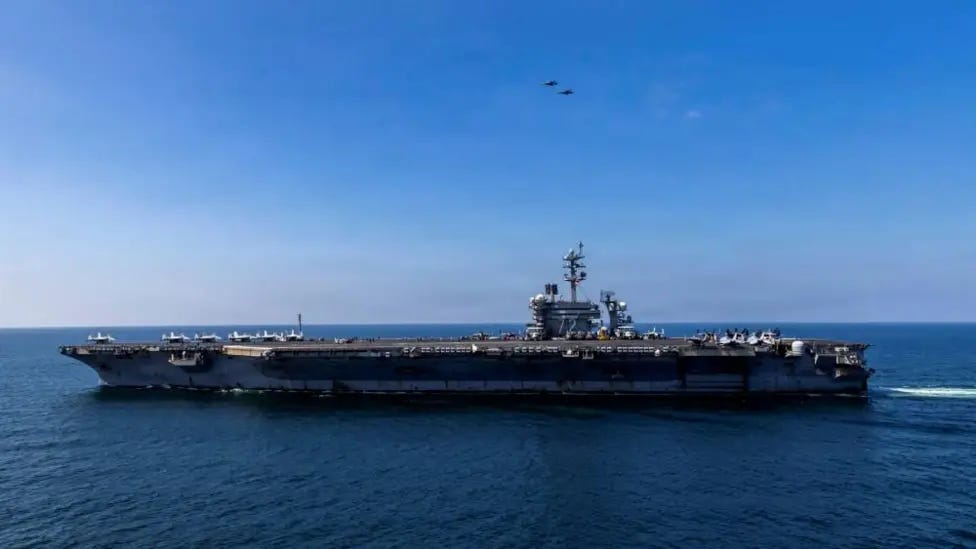
The precise circumstances aboard one carrier are less important here than the underlying issue. Ships have technical endurance. They have logistical endurance. They also have human endurance. Those three things are not necessarily the same.
So, we should be careful about judging all ships based on one deployment. Still, the bigger issue is hard to ignore.
A nuclear-powered aircraft carrier demonstrates the distinction particularly well. Its propulsion endurance can be measured in years. Fuel, food, ammunition and aviation stores can be replenished at sea.
The people cannot. Eventually sailors need rest and recovery. Sustained operational tempo builds fatigue, no matter how capable the surrounding platform may be. This is important for today’s Royal Navy. Just as demands on the fleet are rising, we’re also trying to send fewer people to sea.
The Lean-Manning Paradox
Automation unquestionably allows smaller crews. But smaller crews create a paradox. During normal operations, automation replaces people. But when things go wrong, the people left on board might suddenly have to do the jobs the machines usually handle.
Experience with small-crewed ships shows how tough this can be. Sensors and automated systems can cut down on routine checks and watchkeeping, but sensors can break, wiring can get damaged, and signals can become unreliable.
At that point somebody has to investigate. And fewer people are around to do it. This matters particularly in damage control because much of it remains intensely physical.
Fire.
Flooding.
Structural damage.
Smoke and toxic gases.
Loss of electrical power.
Damaged communications.
These aren’t just numbers on a screen. Someone still has to find the problem, shut down machines, set up barriers, move gear, fight fires, or stop flooding.
The problem is increasingly recognised in work on lean-manned and autonomous naval platforms. Work on lean-manned and autonomous platforms increasingly recognises that damage control cannot simply be treated as another function from which people can be progressively removed.
A ship built with just enough people for normal operations might not have enough hands when things go wrong and more help is needed. That is the lean-manning paradox.
The more a ship relies on fewer people, the more important each person becomes if the automation stops working.
The Hybrid Navy Changes the Equation
None of this argues against autonomy. Quite the opposite. A genuinely uncrewed vessel offers an entirely different approach to survivability. If no sailors are on board, there’s no need to keep living spaces safe or make sure there are escape routes through machinery areas. Engineering systems can be built in modules and kept separate. If one part is damaged, it can just shut down. In some cases, the whole platform can be left behind.
The mistake would be to assume that an autonomous vessel should be a conventionally crewed warship with the accommodation removed. It can be designed around entirely different assumptions. That difference is important. The dangerous middle ground may actually be the lean-crewed warship.
It retains people and therefore has to protect them.
It retains complex combat systems.
It must recover from battle damage.
It must maintain watches.
It must operate for weeks or months.
But it has fewer people on board when things don’t go as planned.
And in war, things often don’t go as planned.
The People Who Aren’t Aboard
The Hybrid Navy also challenges what we mean by a ship’s company.
In August 2026, a routine cyber vulnerability assessment of the Royal Navy’s new K3 Scout uncrewed surface vessels detected that one of their cameras was making heartbeat communications to a Chinese IP address.
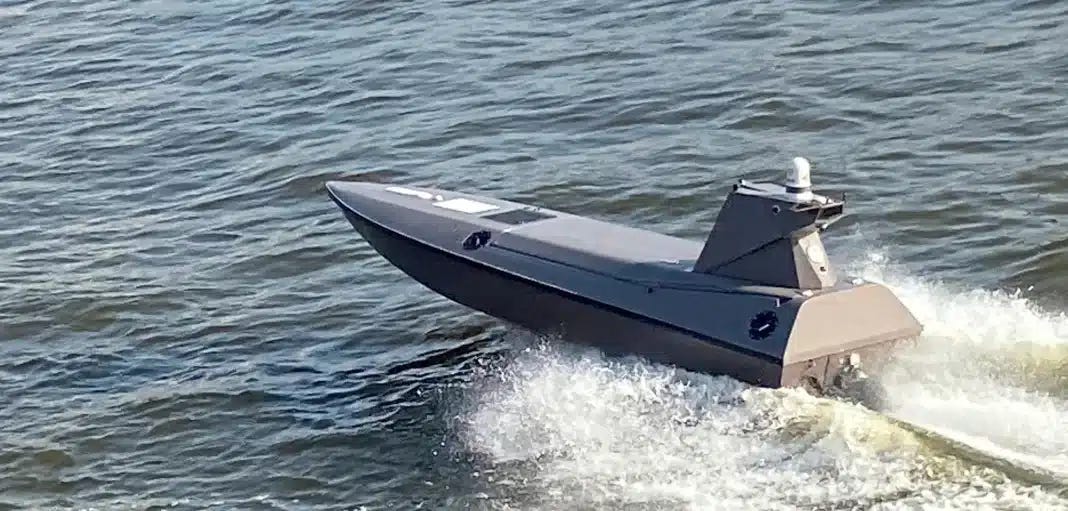
According to the Ministry of Defence, subsequent investigation found no evidence that MoD data or systems had been accessed, compromised or transmitted externally. The camera was provided through a third-party supplier, despite the prime contractor receiving security assurances.
In one sense, the incident demonstrates that assurance worked. Testing detected the unexpected behaviour. But it also illustrates how different the workforce problem becomes with an autonomous fleet.
A K3 does not require a sailor standing beside its camera. It still requires people who can understand what that camera is doing. Modern autonomous vessels contain layers of hardware, firmware, software, communications and data dependencies assembled through complex supply chains. A component several levels below the prime contractor can introduce behaviour that neither the customer nor perhaps the prime originally anticipated.
You can check the vessel and still not know exactly what it’s doing. Taking sailors off the ship doesn’t remove the need for people—it just shifts it somewhere else.
Someone must assure the hardware.
Someone must test the software.
Someone must monitor network behaviour.
Someone must validate updates, manage configuration, maintain the autonomy stack and ultimately decide whether the system can still be trusted. So the Hybrid Navy might need fewer people at sea, but it will depend increasingly on specialists elsewhere.
Procurement Becomes Part of the Fighting System
The K3 incident also exposes another challenge. Autonomous systems derive part of their military value from their ability to evolve quickly. Sensors can change. Payloads can be replaced. Software can be updated. Commercially derived technology can potentially be introduced far faster than equipment aboard traditional warships.
That is a feature, not a problem.
RUSI’s work on “prototype warfare” argues that the Royal Navy needs precisely this ability to field immature capabilities, learn through operational use and rapidly improve those that demonstrate value. It describes operators not simply as consumers of finished equipment, but as “prosumers”, participating in the development of capability through use, feedback and data.
But speed cannot mean abandoning assurance. The K3 experience suggests almost the opposite. If the Hybrid Navy is to incorporate technology faster, assurance itself must become faster and continuous.
The answer cannot be to subject every camera, processor or software update to the procurement cycle of a conventional warship. Nor can it be to trust the supplier and hope for the best. The Royal Navy will need to learn how to procure quickly, test continuously and distrust intelligently.
That creates another demand for people. The sailor of the Hybrid Navy may be an operator, maintainer and damage controller. But the wider Navy will increasingly depend upon software engineers, cyber specialists, data scientists, AI assurance teams, remote operators, commercial maintainers and industry partners. People are still a key part of naval power.
That role has just grown beyond the ship itself.
People as Reserve Capacity
An interesting historical parallel emerges here. The fighting strength of the Falklands Task Force was never simply the sum of the complements aboard Royal Navy warships. Merchant seafarers, RFA crews, dockyard workers, engineers, logisticians and industry formed an extended human system that allowed the fleet to operate and adapt 8,000 miles from home.
The technology has changed profoundly. The principle has not.
Far more people keep a fleet running than just those on board.
And those people offer something that’s hard to show on a staffing chart. They provide reserve capacity. A sailor is not simply a unit of workforce assigned to a task. A sailor whose normal job is operating a weapon may become part of a firefighting team. An engineer may help recover a damaged electrical system.
Someone off watch becomes another pair of hands moving equipment, carrying casualties or establishing a damage-control boundary. And the same principle applies beyond the ship.
Engineers modify equipment.
Software specialists diagnose unexpected behaviour.
Maintainers improvise repairs.
Logisticians reroute supplies.
Industry finds another way to manufacture something that is suddenly required.
People find ways to adapt.
The Falklands Task Force did this constantly. Today, we’d probably call this resilience.
Back in 1982, it was just what people did.
Designing for the Bad Day
The Hybrid Navy offers an opportunity to use scarce sailors much better.
Uncrewed systems can undertake persistent surveillance. Autonomous vessels can extend the sensor network. Remote weapons platforms may add magazine depth. Artificial intelligence can reduce the burden of analysing ever-growing volumes of information.
This is needed if the Royal Navy wants to get more out of the people and resources it has. But we need to be clear about what we mean by efficiency. The objective should not simply be to minimise the number of sailors aboard every future warship.
Maybe the better goal is to cut down on the routine tasks sailors have to do, so they’re only needed when it really matters. That’s a small but important difference. Automation should create human reserve capacity rather than simply provide an opportunity to cut posts.
It means watching for crew fatigue just as carefully as we check the health of the machines.
It means planning damage control based on the number of people actually available at 3 a.m. after days at action stations, not just the number listed on paper.
It means building truly uncrewed platforms from the start, not just reducing the crew on a regular ship until no one is left.
And it means realising that some of the people a warship relies on might be hundreds or even thousands of miles away.
The Question We Should Be Asking
Forty-four years ago, the Falklands Task Force demonstrated that sophisticated technology and enormous logistical complexity could be held together by trained people capable of adapting when the plan failed.
Today’s Royal Navy is attempting something equally ambitious. It wants to distribute combat power across crewed and uncrewed platforms, use artificial intelligence to accelerate decisions and generate greater maritime mass without requiring a proportionately larger Navy.
That’s the right approach. But there is a danger in treating sailors purely as a cost to be engineered out. The crew on a ship is also a source of resilience. And the people who support that ship, whether aboard an RFA, in a dockyard, inside a remote operations centre, writing software or examining a suspicious packet of network traffic, are increasingly part of that resilience too.
Technology might mean you need fewer people when everything is running smoothly. But warship design also needs to consider how many people are needed when things go wrong.
Perhaps that is the enduring lesson connecting the South Atlantic in 1982 with the Hybrid Navy of the 2030s. The future fleet should not be designed simply around the minimum number of sailors required to operate it. It should be designed around the number of people and the amount of automation required to survive its worst day.
And some of those people may never go to sea.
Further Reading
Royal Navy / Naval Damage Control, “Damage Control on Lean-Manned and Autonomous Platforms”
Navy Leaders SiteRUSI, “Prototype Warfare in the Maritime Domain”
LinkUS Naval Institute, “The Logistics Miracle”, Peter Hore, 2022
Peter Hore’s account of Ascension and Falklands logistics provides the historical background to the Task Force’s wider human system, extending far beyond the complements of its warships.
The Logistics MiracleUS Naval Institute, “Lessons for a Wartime Navy from STUFT Vessels in the Falklands War”, 2024
Lessons for a Wartime Navy from STUFT Vessels in the Falklands WarR. Adm. James Parkin, “Delivering the Hybrid Navy: Challenges and Opportunities”,
Council on Geostrategy / Britain’s World, 2026The Last Mile: Sustaining the Hybrid Navy
·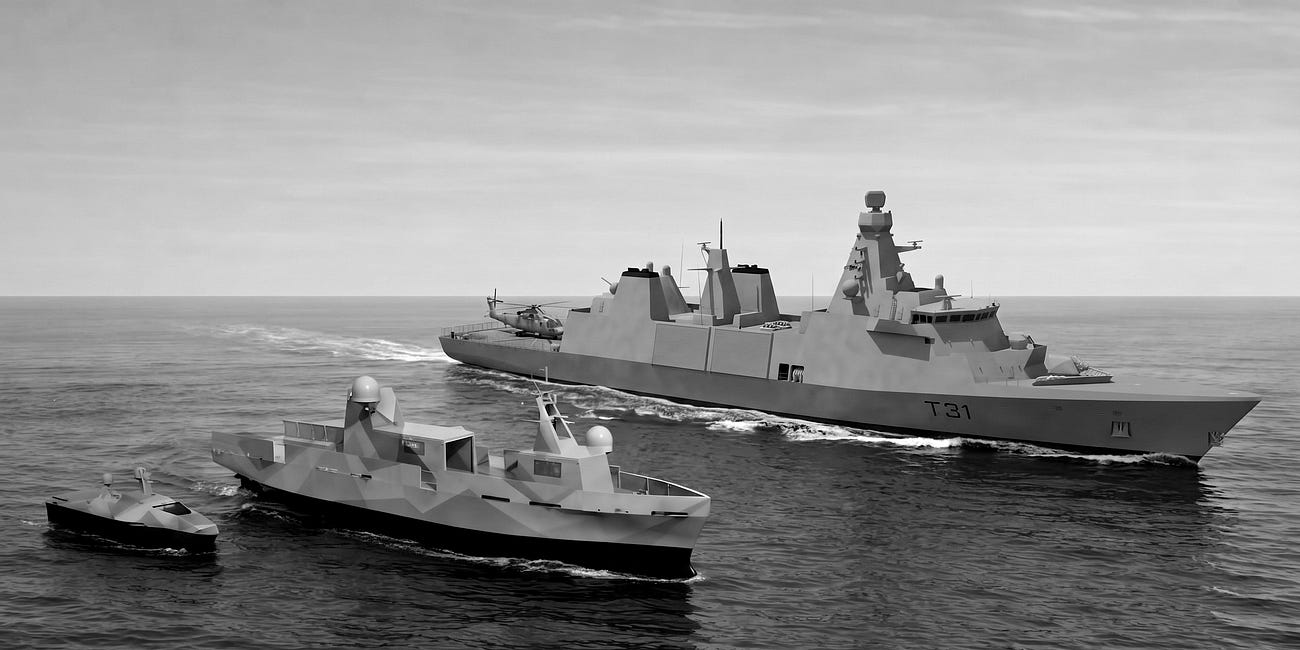
The Hybrid Navy is steadily moving from concept to reality.

I was fixing them up and sending them back to work. Thanks for your service fellow Navy veteran. Keep showing up and writing.
Great piece Richard. Loved in the insights from the Falklands Conflict; whether we're talking about survivability and damage control or any other topic, lessons are much easier to absorb when they're rooted in real-world experience!