

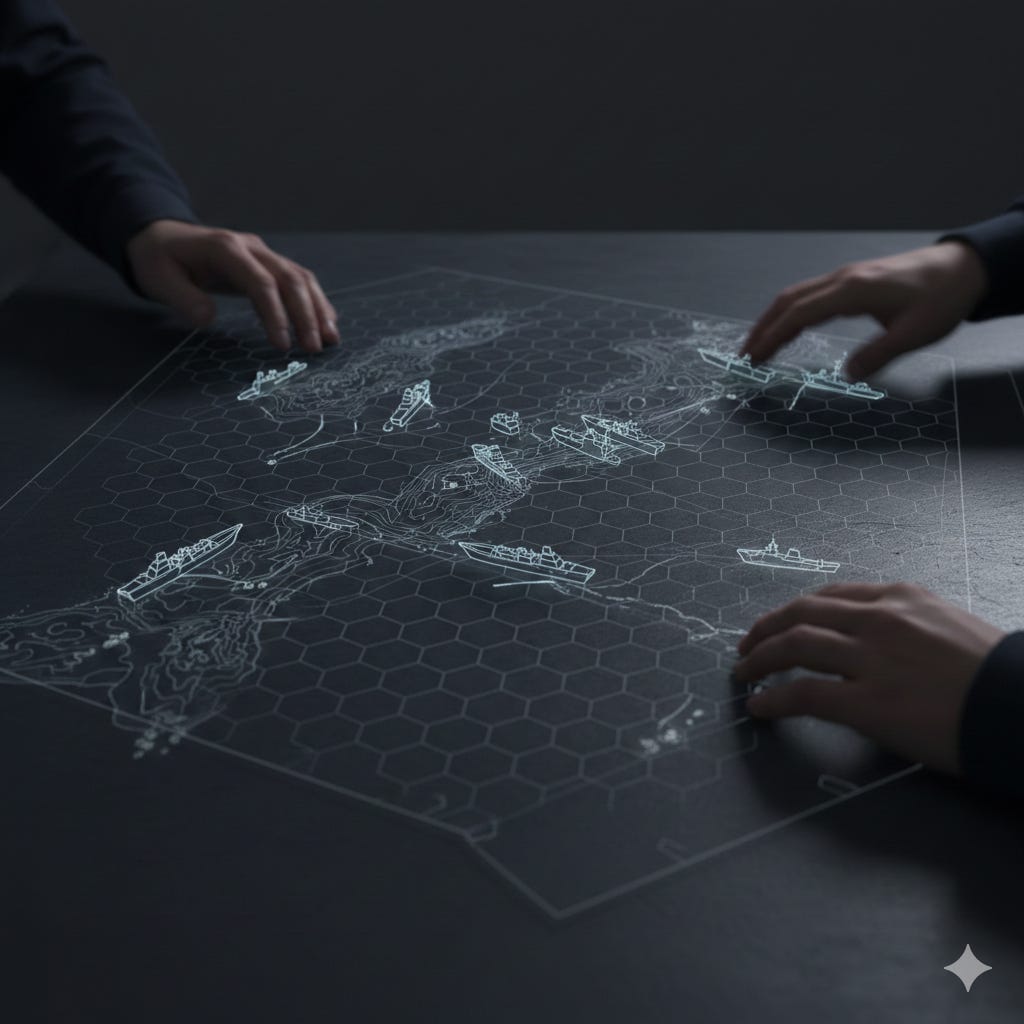
A recent online article by a Royal Navy officer (link in further reading below) presents a well-argued and timely case for expanding synthetic training and wargaming across the Service. The article is well-sourced and clearly written, reflecting the standards of the Royal Navy Strategic Studies Centre. In an earlier Future Navy post on Threat Evaluation and Weapon Assignment (TEWA), I looked at how machines help commanders decide what matters most in combat. This wargame item asks the harder question of what happens when those decisions are tested under pressure.

Much of the diagnosis is correct. The intent is right. The direction of travel aligns with what allied navies are already doing, and with what the First Sea Lord Gwyn Jenkins has been signalling publicly about preparedness, realism, and meeting the demands placed on today’s sailors.
This article deserves serious consideration. But it also stops short of saying the one thing that truly matters. The Royal Navy does not have a training problem. It has a credibility and risk-ownership problem.
Wargaming is important not only for skill development but also for revealing uncomfortable truths. This challenge has hindered its integration.
Where the original article is right
The original article gets three big things right.
First, platform scarcity now shapes training opportunity rather than the other way around. That is an unavoidable reality.
Second, the complexity of modern warfare has outpaced what can reliably be recreated at sea. Synthetic environments are no longer optional; they are essential.
Third, wargaming and low-friction simulation develop judgment, intuition, and systems thinking in ways that lectures, checklists, and scripted exercises never will.
The recommendation to expand training beyond advanced simulators to include tabletop, paper, and commercially available wargames is particularly significant. This is where meaningful cultural change starts.
On these points, there should be broad agreement.
The quiet truth cannot quite state
The article does not fully address why wargaming is difficult to institutionalise. Wargaming challenges organisations not because of cost or complexity, but because it exposes underlying assumptions.
Effective wargames do more than train personnel. They reveal:
Where force structure breaks
Where mass is insufficient
Where deterrence relies on availability that does not exist
Where plans are sustained by hope rather than capability
This is why wargaming cultures often fail due to institutional resistance rather than lack of enthusiasm.
When career advancement relies on positive readiness reports and reassuring briefings, repeated honest wargaming is viewed as a risk rather than a benefit.
Project SPARTAN and the illusion of a solution
Project SPARTAN is described as a necessary, though delayed, solution. This assessment is accurate but incomplete.
Large, integrated synthetic environments tend to produce:
Limited access
Specialist ownership
Event-based use
Carefully curated outputs
They rarely drive daily cognitive change across the fleet.
Wargaming culture is not created by platforms.
It is established through permission.
Without explicit senior support for uncomfortable findings, SPARTAN risks being impressive rather than transformative.
The real blockers we need to name
If the Royal Navy is committed to progress, it must be honest about the true barriers.
Classification is often used as a safeguard. Most effective wargaming does not require highly sensitive intelligence, but rather plausible constraints, red teaming, and intellectual honesty.
Risk continues to be managed at lower levels. Junior officers are encouraged to innovate in theory, but they still face career risk. Behaviour will not change until senior leaders actively protect against failure in synthetic environments.
Participation is often mistaken for impact. Conducting a wargame is not equivalent to implementing its findings. Many uncomfortable insights are set aside because they have implications for force design.
Most importantly, wargaming is still viewed as an educational tool rather than a design process. Its true value lies in determining what should not be expected of personnel, not just improving current capabilities.
This discussion is largely avoided.
The real test is not just fighting.
There is a deeper test that wargaming must confront, and it goes beyond tactics, formations, or who wins the engagement.
It is whether our models of war still assume a linear, sequential fight.
In much Royal Navy training culture, including historically within Fleet Operational Sea Training, combat has often been framed as a progression. You fight. You take hits. You then transition to damage control. Weapons teams become damage control parties. The battle moves on.
While this logic appears straightforward in planning, it is inaccurate. In actual conflict, phases do not occur sequentially. My own experience, and that of many others who have been under fire, is that ships do not get the courtesy of finishing one problem before the next arrives. On HMS Ardent in the Falklands Conflict of 1982, there was no clean handover from fighting the enemy to fighting the ship. The crew had to do both at the same time, with shrinking manpower, failing systems, broken communications, and wounded people.
This distinction is critical when discussing wargaming. If a wargame assumes that a ship can:
Absorb a hit
Pause the fight
Reassign weapons teams to damage control.
Then re-enter the battle.
In this case, the wargame is not testing reality but maintaining a reassuring narrative.
Logistics, missiles, and the myth of endurance
The same problem applies to logistics and weapons. Too many games still assume:
Missile stocks that are effectively infinite
Replenishment that is timely and uncontested
Platforms that remain fully mission-capable until decisively removed
Modern warfare does not operate in this manner.
A serious wargame must ask:
What happens after the first wave of missile expenditure?
How long can a task group fight once vertical launch cells are empty?
What does deterrence look like when reloads are measured in weeks, not hours?
What happens when logistics vessels are threatened or unavailable?
How do degraded ships continue to fight while simultaneously keeping themselves afloat?
These are not rear-area logistics questions. They are warfighting questions at the point of contact, this is discussed in detail in this Future Navy post:
Beyond the First Salvo

Despite the advances in naval missile systems over the past four decades, a fundamental limitation remains unaddressed: most modern warships are still designed to fire once and then withdraw.
A Navy that does not accurately model missile depletion, spares exhaustion, crew fatigue, and damage control under fire is not preparing for war. It is conducting a theoretical exercise.
Why this matters for wargaming culture
At this point, wargaming becomes genuinely challenging. A properly constructed, junior-led, repeatable wargame should be allowed to conclude that:
A ship still in the fight cannot spare people for damage control.
A task group must disengage because it is out of missiles, not courage.
A platform survives the hit but loses relevance because its sensors, power, or crew are degraded.
Logistics failure ends the operation more decisively than enemy fire.
These outcomes are not failures; they are the purpose of the wargame. They are dismissed as unrealistic; the organisation is not protecting realism. It is protecting identity.
The credibility question
The Royal Navy’s credibility does not rest on whether it can win the opening exchange. It rests on whether it can:
Sustain combat under attrition.
Fight while damaged, not after damage
Make hard choices about when ships withdraw.
Admit where mass, logistics, and people are insufficient.
Wargaming is one of the few tools that can prompt these discussions early, cost-effectively, and transparently. However, this is only possible if logistics, missile stocks, and damage control are treated as decisive variables rather than background assumptions.
Saying the quiet part out loud
The original article is right to argue that wargaming and synthetic training matter. It is also, by necessity, right to frame them as enabling tools. However, what must now be stated clearly is this.
Wargaming is not primarily about readiness, it is about honesty.
It is about aligning ambition with resources, commitments with capacity, and rhetoric with reality.
The Royal Navy does not need better synthetic environments to tell itself reassuring stories.
It requires repeatable, rigorous tools that compel honest assessment of what can and cannot be credibly deterred, defended, and sustained. Wargaming can do that.
However, this will only occur if we acknowledge that wargaming is not risk-free.

Excellent piece, subscribed after reading your Atlantic Bastion article.
Very keen to read your back catalogue and see what you produce in the future.
From your own time serving, how many exercises synthetic and live did you see where red forces won?