

Why this matters now
The First Sea Lord’s directive is clear: prepare the Navy for warfighting, quickly, while prioritising autonomy and innovation. This vision explicitly includes the development of uncrewed escorts and hybrid air wings to enhance mass and persistence, all while ensuring that people remain at the centre of the force.
At sea, a digital backbone is already being introduced. Shared Infrastructure is consolidating numerous combat systems into a common computing environment and operator console across various classes of vessels. This presents both an opportunity and a need for new skills, workflows, and training.
Underwater, the operational landscape is growing increasingly complex. Protecting cables, tracking submarines, and coordinating mixed groups of crewed and uncrewed vehicles demand robust sensors, resilient networking, and operators who can interpret imperfect data amidst electromagnetic interference. This is precisely where AI-assisted Tactical, Environmental, and Warfare Analysis (TEWA) and autonomy can provide an advantage—if the human operators are adequately prepared.
Who are we preparing? Gen-2007 (Average age 23 in 2030)
These sailors were schooled through COVID, learned online by default, and think in terms of apps, feeds, and automation. They are adaptable and tech-savvy, but their formative years were marked by fragmented schooling and fewer tactile experiences. They will excel with a clear purpose, intuitive tools, and coaching loops, not manuals and a hierarchical structure. The cultural task is to harness that agility without losing the discipline and duty-holding that define seafaring.
The 2030 skill map
Human–machine teaming & TEWA literacy — understanding how AI proposes and ranks actions, and when to override it.
Mission-data discipline — tagging, triaging, and feeding sensor data into models; knowing that data hygiene is fire-control accuracy by another name.
Autonomy operations — managing loyal wingmen, USVs, and UUVs, and knowing when to trust, verify, or degrade gracefully.
Cognitive load management — mastering console workflows so that operators fight the plan, not the interface.
Digital backbone fluency — treating the ship’s shared compute, patching cycles, and cyber hygiene as operational enablers.
Subsea network awareness — fusing acoustic, optical, RF, and delayed data into a coherent underwater COP.
Assurance mindset — understanding risk, documenting AI behaviour, and maintaining human accountability.
The friction points
Lean manning meets learned instincts; automation surprises outpace trust; damage-control logic clashes with attritable design. Data poverty and EM-contested C2 remain the enemy of every algorithm. Each of these is a people problem before it becomes a technical one.
Bridging Two Digital Revolutions
Lessons from the Royal Navy’s first encounter with computerised warfare
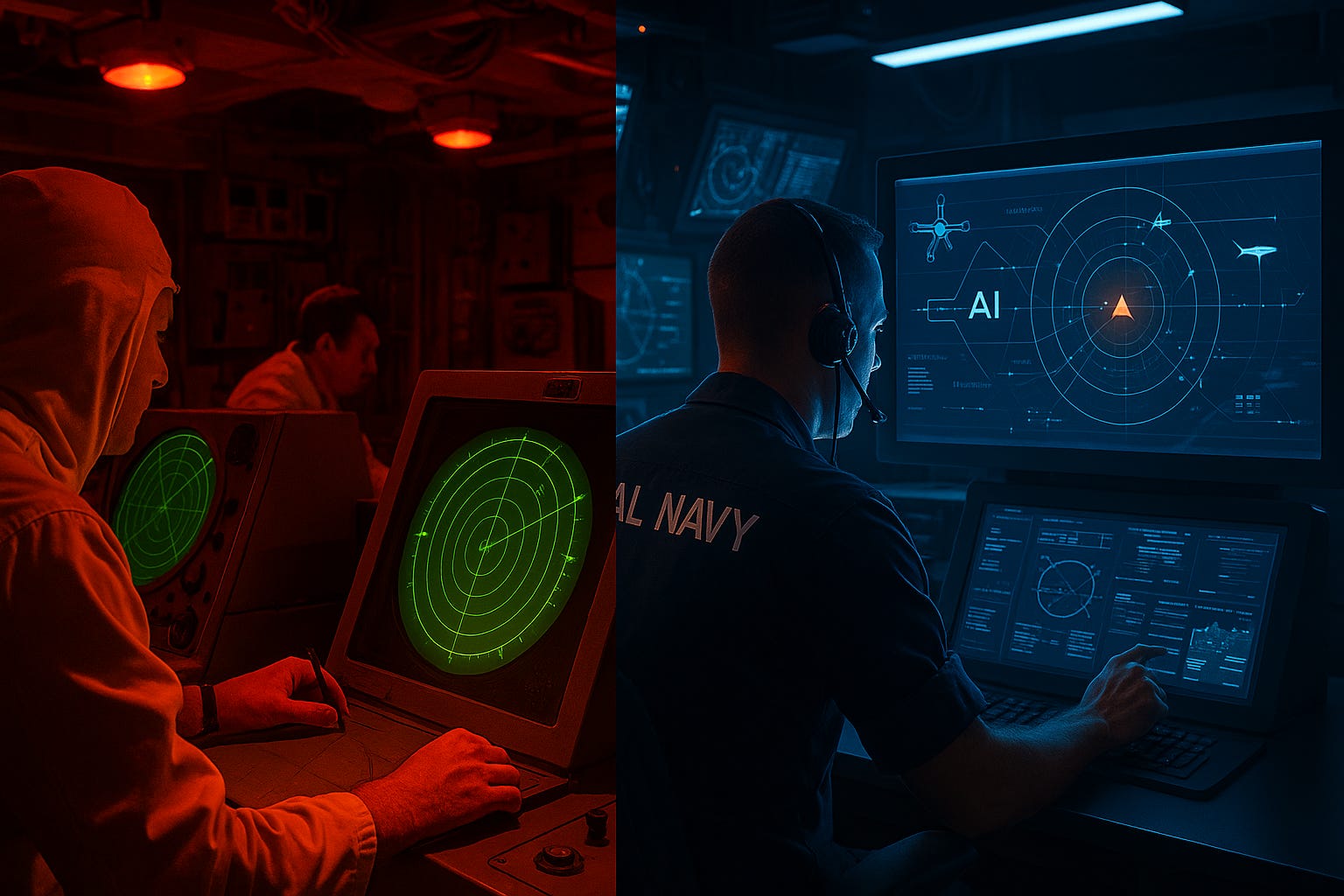
The Navy has faced this challenge before. The first digital revolution arrived almost half a century ago, when the Service moved from mechanical gunnery control to early computer-assisted combat systems.
In the 1970s, naval gunnery was still an analogue craft of bearings, hydraulics, and shouted orders over sound-powered telephones. By the decade’s end, systems such as CAAIS (Computer-Assisted Action Information System) and the Ferranti WSA-4 digital weapon system began to reshape the Operations Room. For the first time, radar plots and synthetic symbols merged on a single display, and the fire-control “tables” of the past gave way to electronic computation.
The transition revealed a familiar pattern: hardware advanced faster than the human system. Sailors trained in the rhythm of turrets and relay logic struggled to adapt to data-driven consoles. Younger operators, fluent with keyboards and digital displays, proved quicker to interpret and act on new systems.
During the Falklands conflict, that generational divide became operationally significant. Ships equipped with digital command systems often relied on their newest specialists to maintain combat tempo under fire. The experience underscored a truth that still holds: technology cannot simply be installed; it must be absorbed.
Today’s transition to autonomy and AI-enabled TEWA is different in scale but identical in nature. Then, the Navy had to teach gunners to trust computers; now it must teach operators to understand and question them. In both cases, success depends less on silicon than on how quickly sailors adapt their instincts, language, and trust to match the machines beside them.
A training blueprint for 2030
1. Pre-entry pipeline — short, accredited courses in cyber hygiene and mission-data tagging; coding and systems logic integrated into cadet and school outreach.
2. Phase-1/2 integration — early exposure to live Shared Infrastructure consoles and workflow-oriented HMIs; human-machine teaming simulations where AI is sometimes wrong, forcing evidence-based judgment.
3. Branch specialisation — TEWA labs and autonomy-operations qualifications covering launch/recovery, comms loss, payload protection, and model assurance.
4. Continuous learning afloat — “algorithm after-action reviews” after each serial, with findings logged to a central AI assurance record. Data triage becomes a watchkeeping responsibility.
5. Leadership and culture — officers and chiefs trained to articulate risk appetite, set autonomy bounds, and recognise cognitive overload in their teams; culture built on People first, Tech always.
Policy & workforce actions
Make JSP 936 lived, not laminated — translate assurance policy into unit-level drills and risk cards used alongside night orders.
Build an AI-ready career lattice — recognise and retain data and autonomy specialists through dedicated advancement routes.
Standardise console and classroom — replicate operational CMS builds across all training sites.
Treat subsea networking as a trade — formalise a Subsea Network Operator skill code and trial syllabus.
Rewrite the damage-control doctrine for autonomy — define manual fallbacks, trust thresholds, and attritable end states.
Institutionalise model feedback — a central repository for algorithm AARs and lessons learned.
War-game the people, not just the platforms — measure human-machine teaming performance as a readiness metric.
Bottom line
By 2030, the Royal Navy’s advantage will not lie in having AI or autonomy — it will lie in the human teams able to think, decide, and trust at machine speed.
The Service has navigated this transition before. The 1970s digital revolution taught that new technology only delivers its full potential when users adapt to it. This time, the Navy must get ahead of the curve, training the Gen-2007 cohort not just to be operators of autonomous systems, but also confident partners with them.
Further reading
Defence AI Assurance (JSP 936 in practice) — governance and risk in daily operations.
Shared Infrastructure — RN’s digital backbone — how common compute reshapes the CIC.
Thales TACTICOS Operator-Centric HMI — workflow design and cognitive ergonomics.
Exploiting the Underwater Battlespace — the subsea data and autonomy challenge.
NDC Feature: Damage Control on Lean-Manned and Autonomous Platforms — human factors and automation paradoxes.
First Sea Lord interview (RNRMC) — autonomy at scale, people at the centre.