

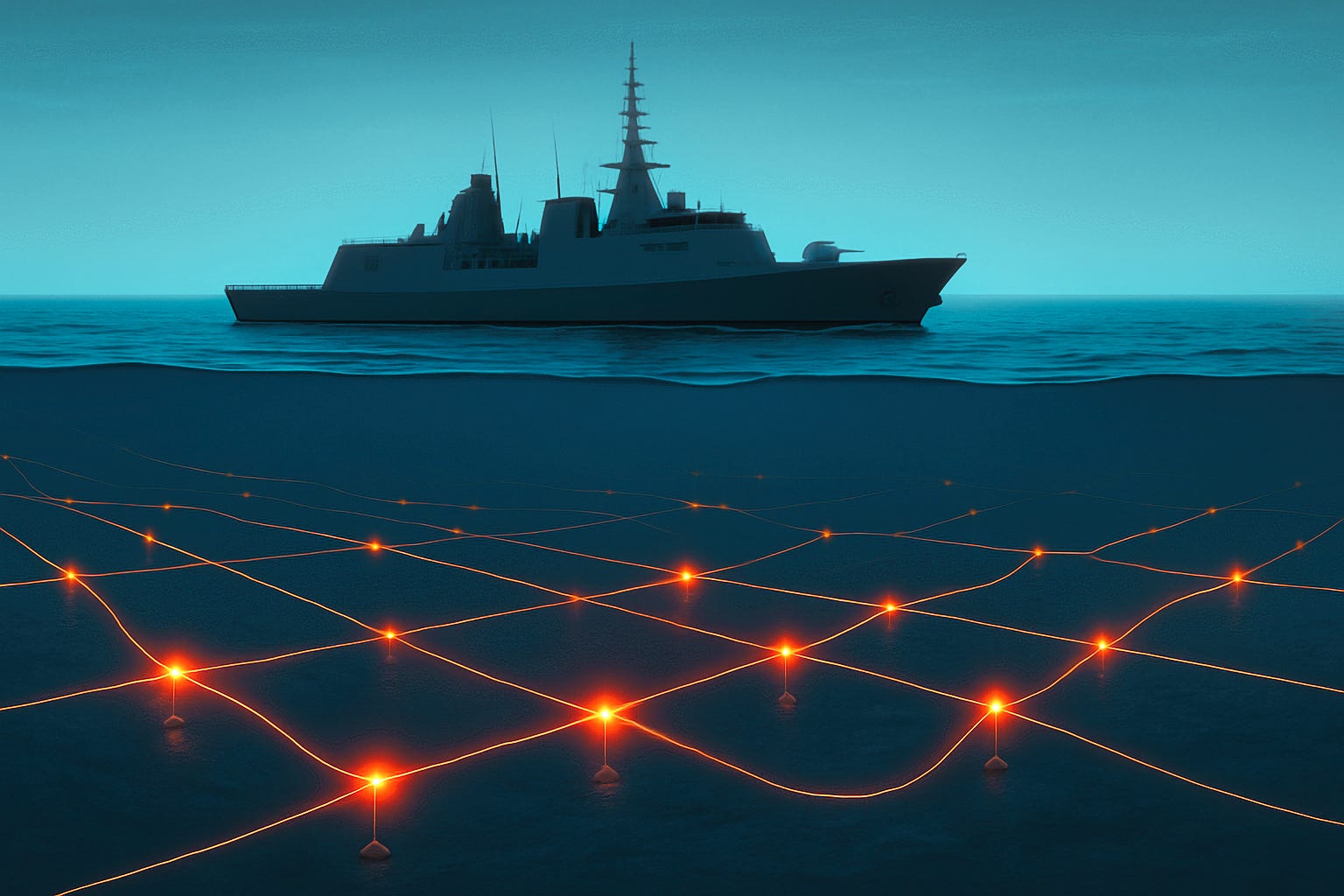
The Royal Navy’s digital transformation is progressing steadily and significantly. What started as an engineering initiative to streamline shipboard computing has transformed into a comprehensive architecture for modern warfare. The Shared Infrastructure environment now serves as the foundation for over thirty combat systems, navigation, sensors, and weapons management within a secure cloud network across various ship classes.
This new approach replaces outdated hardware with software-defined capabilities and establishes a common data layer among the ships. The impact is substantial: it focuses less on efficiency and more on agility, allowing the fleet to adapt through software changes rather than relying solely on physical modifications.
This digital backbone is becoming increasingly multinational.
In September 2025, Saab and its MANGROVE consortium began working on NATO’s Allied Underwater Battlespace Mission Network (AUWB-MN). This project is part of NATO’s Digital Ocean and ASW Barrier Smart Defence initiatives and aims to establish a reference architecture for underwater interoperability across twelve nations. The network will integrate both crewed and uncrewed systems, both above and below the surface, by fusing sonar, acoustic, and environmental data quickly and efficiently.
For the UK, this positions the Royal Navy as a leading contributor to the creation of an alliance-scale underwater internet, a system in which national assets become connected nodes within a collective battlespace picture.
This evolution raises fundamental questions of trust and control.
As digital complexity expands, so too does the reliance on autonomous and semi-autonomous decision-support tools.
Research from The Alan Turing Institute — notably AI Won’t Replace the General — highlights a recurring challenge: synthetic intelligence may accelerate situational awareness, but it also shifts the cognitive burden onto leaner command teams.
The result is an operating environment in which human judgment must coexist with algorithmic inference, requiring new forms of assurance and oversight.
To that end, the Ministry of Defence’s JSP 936: Dependable AI in Defence and the accompanying Defence AI Assurance study mark a significant policy advance. They establish a practical workflow for verifying AI systems through structured system cards that document design intent, training data, test conditions, and operational limits.
This approach reframes assurance as a continuous process rather than a final check. It embeds legal, ethical, and technical accountability into every AI-enabled capability — a necessary precondition for operational confidence at machine speed.
These frameworks are not theoretical.
Computer-vision models, automated threat-evaluation software, and autonomy controllers for uncrewed surface vessels are already being assessed against JSP 936 criteria.
Each case contributes to a growing evidence base on how artificial intelligence behaves under maritime conditions, and how commanders can interpret its advice with appropriate confidence.
The Royal Navy’s experience will influence NATO standardisation, ensuring that allied AI deployments remain interoperable, auditable, and lawful.
Leadership remains central to this process.
In his first hundred days as First Sea Lord, General Sir Gwyn Jenkins has emphasised the need to deliver innovation at pace while maintaining human primacy in decision-making.
His intent, that every crewed vessel should operate with uncrewed partners, supported by a dedicated delivery hub in Portsmouth, illustrates how digital transformation is now tied directly to force structure.
The Navy’s challenge is to scale technology without eroding accountability, ensuring that autonomy extends reach, not responsibility.
The strategic logic mirrors a historical precedent.
Eighty years ago, the Flower-class corvettes provided anti-submarine mass through simplicity and numbers. Today, the same imperative is re-emerging through digital means.
As Navy Lookout recently observed in its feature “Echoes of the Flower-class Corvettes”, the Royal Navy is once again seeking ways to increase anti-submarine warfare mass, not solely through new hulls, but through scalable, networked systems capable of persistent presence.
This broader shift, from industrial mass to informational mass, underpins the Digital Ocean concept. Where the corvettes once filled the Atlantic with steel, the next generation will fill it with sensors, data, and code.
Securing this Digital Ocean will depend less on individual platforms and more on the coherence of their architecture.
Shared Infrastructure, the NATO mission network, and assured AI governance form an interdependent triad: hardware, data, and trust. Together, they define the conditions under which the Royal Navy and its allies can operate confidently in an increasingly autonomous battlespace.
The invisible fleet is already forming. Its resilience will rest on how well we understand, assure, and command it.
Further Reading
BAE Systems Digital Intelligence (2025) – Exploiting the Underwater Battlespace
A clear articulation of the subsea threat, defining the ISR–ASW–CUI triad and the case for autonomous networking.
🔗 baesystems.com/digital
The Alan Turing Institute (2025) – AI Won’t Replace the General
A grounded study on human–machine decision-making in command environments — essential context for “meaningful human control.”
🔗 turing.ac.uk
Royal Navy – Strategic Defence Review 2025: Making Britain Safer
The first to formally identify the “Atlantic Bastion” and the requirement for a layered sensor network above and below the waterline.
🔗 gov.uk/mod
NATO Digital Ocean Initiative (2024)
A framework for fusing subsea sensors, autonomy, and AI across alliance waters — underpinning many of today’s REPMUS and AUKUS trials.
🔗 nato.int
Policy Exchange (2024) – From Seabed to Space
An early warning on how seabed infrastructure became the exposed underbelly of modern power projection.
🔗 policyexchange.org.uk