

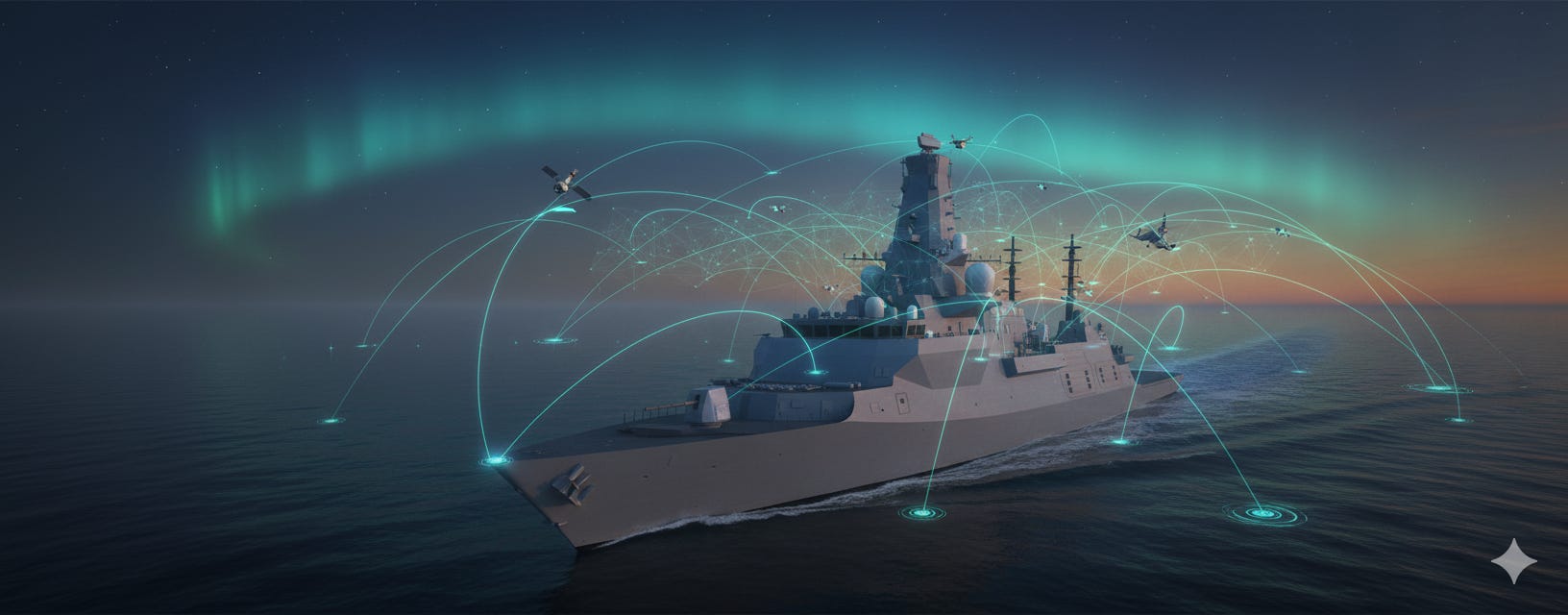
The Navy’s Next Transformation
For centuries, the power of the Royal Navy was measured in hulls and tonnage. Today, it is measured in processing power and data flow.
A significant transformation is taking place across Britain’s new generation of frigates and destroyers: warships are now being designed around the software that connects their systems, rather than the systems themselves.
This revolution is centred on a concept known as Shared Infrastructure (SI) – the digital backbone currently being installed across the fleet. It is fundamentally redefining how the Navy builds, operates, and maintains its ships.
On paper, SI is a secure cloud technology that hosts more than thirty combat systems on a single virtual platform – encompassing everything from navigation to electro-optics and gunfire control. In practice, it transforms each ship into a software-defined warfighting platform that can evolve through software updates rather than requiring physical refitting.
“Shared Infrastructure is the Royal Navy’s digital backbone for warfighting capabilities,” according to an internal description from BAE Systems.
The concept is deceptively simple: consolidate hardware, virtualise functions, and push updates like a smartphone. However, beneath this simplicity lies the foundation of what some naval engineers refer to as “the combat cloud.”
From Steel to Software
Shared Infrastructure (SI) began as a rationalisation program for the Type 23 frigates but has evolved into the architectural model for the Navy’s future. Every new class of ship, from the Type 26 and Type 31 frigates to the Queen Elizabeth carriers, is now designed around a virtualised computing environment in which sensors, effectors, and decision aids operate on a common data layer.
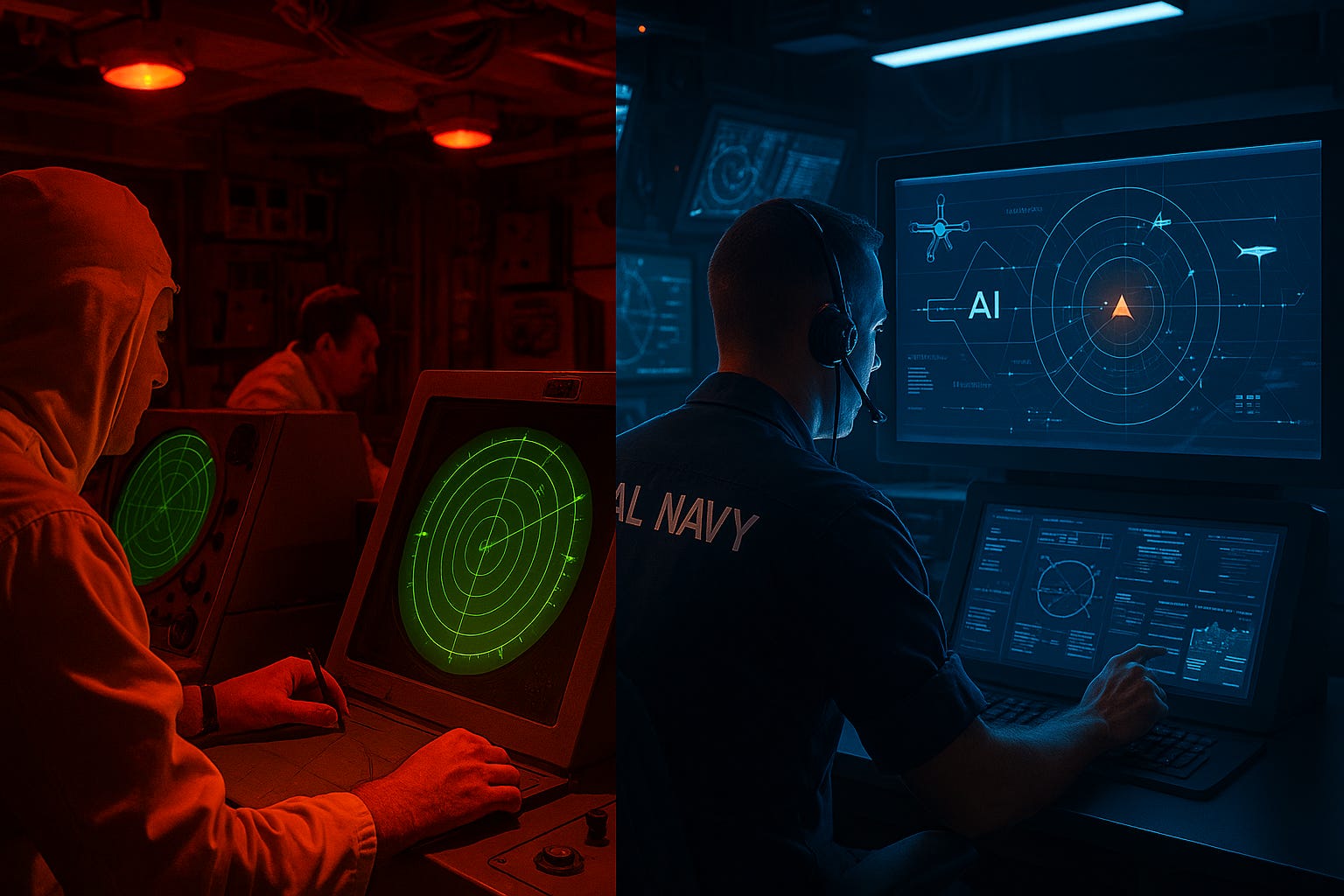
On older ships, adding a new radar or fire-control system involved installing a dedicated console, along with wiring and software tailored to that system. Each component was unique, and upgrades could take years to implement. With SI, these functions are hosted on a modular virtual network. Engineers can add or update capabilities by simply loading new software modules, rather than installing new hardware.
The advantages of this system are both operational and economic. Shared Infrastructure significantly reduces the need for physical hardware, saving space and power while enhancing resilience. It also enables ships to receive fleet-wide software updates, ensuring that every platform operates on the same digital baseline.
In high-tempo fleet operations, where every second counts, having a shared baseline allows decisions made on one bridge to be instantly reflected across other ships.
RECODE – The Engine of the Combat Cloud
Building on this foundation is RECODE RECODE’s all-time Combat System Navy’s Data Enablers – a £285 million, eight-year modernisation program managed by BAE Systems.
The goal of RECODE is to make the Navy’s combat systems genuinely agile, enabling the testing, deployment, and validation of new capabilities in weeks instead of years.
At its core, RECODE provides an agile runtime environment that remains under direct control of the Ministry of Defence. This structure ensures that future software, whether developed by BAE, Thales, or smaller specialist developers, operates on a standard, secure Infrastructure.
As a result, the fleet can host new AI decision aids, sensor-fusion tools, or electronic-warfare applications, similar to adding a new app to a phone.
For technical readers, this initiative represents a step towards a naval version of containerised computing. This distributed environment allows multiple software packages to coexist, scale, and be updated without disrupting the ship’s wider mission systems.
For operators, this means something simpler: increased capabilities delivered faster, without the lengthy dockyard refits that once stalled the fleet’s operations.
“Agility in equipment, process, and mindset will be the determinant of operational advantage.” – Captain Kevin Miller, RN, Combat Systems Lead.
The Human in the Digital Loop
If Shared Infrastructure serves as the backbone of the combat cloud, then TACTICOS, the Thales combat management system installed on the Type 31 frigates, acts as its brain.
TACTICOS has evolved into one of the most advanced open-architecture combat management system designs worldwide. It utilises the OpenSplice DDS real-time messaging standard and features a workflow-oriented human-machine interface (HMI) that prioritises operator cognition over mere engineering convenience.
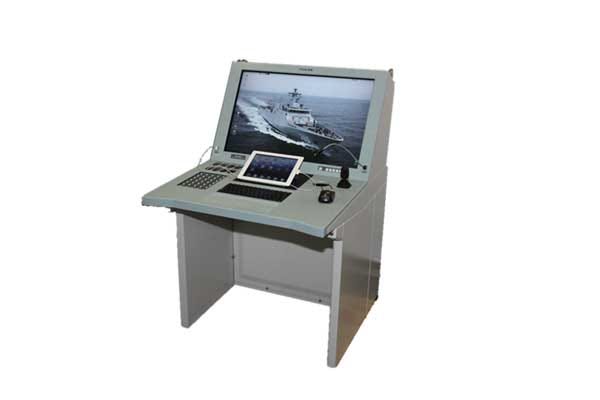
Each console—specifically, the new Multifunction Operator Console Mk 4—combines high-resolution displays, intuitive task-based menus, and integrated collaboration tools. Operators can visualise the entire tactical picture while engaging with intelligent automation that anticipates the likely next steps.
This updated” interface reduces cognitive load and training time while increasing operational tempo. By embedding training simulations within the CMS itself, TACTICOS allows crews to practice various scenarios on the live system, effectively conducting both real-time operations and exercises on the same display.
“The HMI stands out by adhering closely to the operator workflow… the system provides notifications to the right users, at the right moment, and in the appropriate format.” – Thales TACTICOS HMI brief.
Importantly, TACTICOS will operate the Navy’s tenant application on Shared Infrastructure, enabling the same decision-making tools to be used across different platforms. This means that a destroyer and a frigate can share not only information but also capabilities, including data, the same user experience, and the same upgrades.
Assurance at Machine Speed
As combat systems evolve toward software-driven systems, the Navy’s assurance model must also transition to a software-driven approach. Traditional safety certification, once a system was approved, it would remain essentially unchanged for many years. However, in a continuously updated environment, this assumption is no longer valid.
Introducing the Defence AI Assurance framework, developed by the Alan Turing Institute and Accenture, under the Ministry of Defence’s JSP 936 Dependable AI directive. This framework presents a living document, the AI System Card, which records the origin, data sources, risk profile, and operational limits of each algorithm. This serves as the assurance equivalent of version control, enabling commanders to see precisely which software version is in use and the level of human oversight underlying automated decisions.
For naval operations, this is not just a theoretical concept. As AI increasingly plays a role in target recognition, sensor fusion, and autonomous vehicle control, the Royal Navy must ensure that every algorithm remains lawful, explainable, and accountable.
By incorporating RN’s assurance and audit tools into Shared Infrastructure, the Navy can perform continuous verification—what engineers refer to as “assurance at machine speed.” This approach also addresses a key concern of modern command: trusting an algorithm while maintaining control.
Interoperability by Design
Shared Infrastructure and RECODE are national programs with global implications. NATO is adopting the Navy’s open standards, which support the Royal Navy’s combat cloud, under the Federated Mission Networking framework and the new Allied Underwater Battlespace Mission Network (AUWB-MN), a project led by Saab with participation from the UK.
These initiatives aim to connect crewed and uncrewed assets across allied fleets—submarines, surface ships, and autonomous sensors—through common data standards and secure, real-time information exchange. The Royal Navy’s architecture is designed to integrate seamlessly into this ecosystem.
For example, a Type 26 vessel operating in the North Atlantic will eventually be able to share sonar data, threat tracks, or AI-generated situational analysis with a U.S. destroyer or a Norwegian drone without requiring translation. This represents interoperability that is built into systems from the start, rather than being added later.
In practical terms, these “advancements “allow low coalitions to function as a single digital entity, with each unit acting as a node within a multinational combat cloud.
The Evergreen Fleet
The most significant implication of the combat cloud is temporal rather than technical.
For the first time in naval history, a fleet can be continuously modernised without withdrawing ships from service. Software updates can provide new capabilities even while a vessel is deployed, transforming refit cycles into a process of ongoing evolution. “his model resembles the commercial sector’s evergreen IT approach but is applied to warships.
It shifts away from the traditional “block upgrade” mindset toward continuous delivery, reducing the risk of obsolescence and enabling real-time adaptation to emerging threats.
Furthermore, this approach alters procurement economics: capabilities become a recurring subscription rather than a one-time capital investment.
From a strategic standpoint, this model allows a mid-sized power like the UK to maintain technological relevance against larger, numerically superior fleets. The advantage lies not in constructing more ships, but in upgrading “existing ones more” quickly than adversaries can react.
In this context, “the warship becomes a platform for software, not the other way around.”
Risks and Realities
No revolution occurs without challenges. The virtual Navy vision introduces new cybersecurity risks; a compromised update could have widespread effects across multiple ships. Therefore, it’s crucial to have control over the code, ensure independent verification, and maintain strict patch management.
The Navy’s digital teams require the same investment in cybersecurity talent as in traditional resources. Additionally, achieving agility necessitates a cultural shift. Engineers, sailors, and commanders must adopt a developer mindset, working in short iteration cycles instead of adhering to fixed specifications.
The First Sea Lord’s current directive to “innovate at pace” will rely on the service effectively training its personnel to utilise this new structure rather than merely accepting it.
The Shape of Future Fleets
When viewed through the lens of Shared Infrastructure, the broader trajectory of the Royal Navy becomes clear. The Type 26 and Type 31 frigates, designed with open architectures and mission bays, function as interconnected nodes rather than isolated combat units. Carrier strike groups are evolving into hybrid digital formations, where human-crewed ships, drones, and AI systems collaborate in real-time, sharing a common operational picture.
Lessons learned from the RECODE initiative and AI Assurance will directly influence the conceptual design of the Type 83 destroyer and the Next-Generation Submarine Combat System. The Royal Navy is effectively laying the groundwork for a sovereign combat cloud—one that can engage with allies while maintaining independent governance. This represents a pragmatic and evolutionary approach to achieving autonomy and resilience.
The Quiet Revolution
The transition from a hardware-based navy to a software-focused navy may not attract much attention with grand ceremonies or flashy new pennant numbers. Instead, it’s a complex network of code, standards, and data layers that will” shape how the fleet operates for many years to come.
When the first fully equipped RECODE frigate sets sail, the visible changes on deck will be visible. However, beneath the surface, thousands of lines of code will influence decision-making, coordinate sensors, and connect the ship to a vast, invisible network of allied data.
This is the essence of the combat cloud—a fleet that learns, adapts, and continuously updates itself.
Further Reading
Royal Navy Shared Infrastructure overview (BAE Systems internal summary)
Thales TACTICOS Combat Management System – operator workflow and DDS middleware
Defence AI Assurance Report 2025 – Alan Turing Institute & Accenture
CNE 2025 Proceedings – Vice Adm. Paul Marshall, Royal Navy Vision 2040
NATO Allied Underwater Battlespace Mission Network, 2025 – Saab Kockums release