

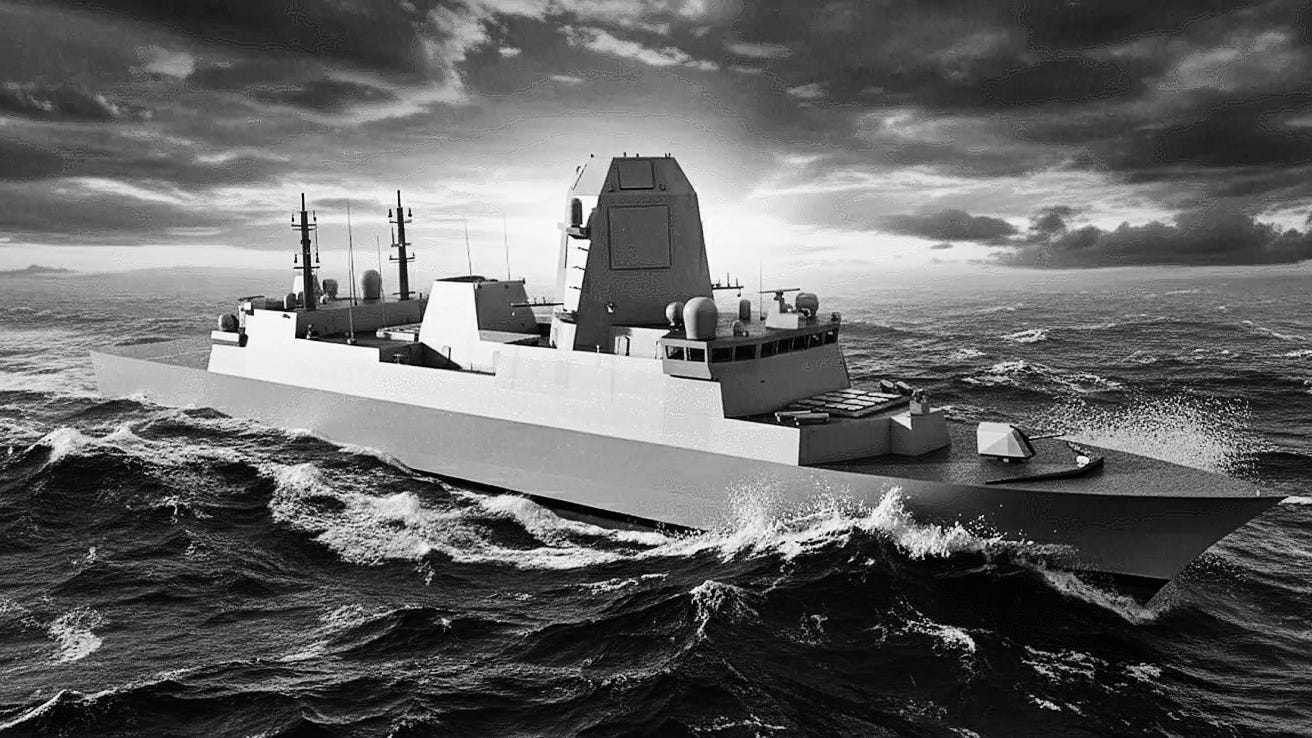
The first two instalments of The AI Shipmate explored how autonomy is reshaping the Royal Navy’s force structure: uncrewed escorts at sea, missing subsea connectivity beneath it. Part 3 turns to the most complex frontier of all, the human dimension of command. How will the Navy lead in a battlespace defined by networks rather than platforms, and by AI assistants rather than traditional watch bills?
The anchor for this discussion is the Future Air Dominance System (FADS), not simply a new capability, but the doctrinal endpoint of the Navy’s emerging hybrid fleet.
From single-hull supremacy to distributed webs
The “one ship, one shield” philosophy of the missile age is running into hard limits.
Magazine depth: Chinese Type 055 destroyers carry 112–138 VLS cells; a Type 45 holds 48.
Geography: Red Sea operations showed the RN can intercept Houthi threats but struggles to strike inland launchers 60 miles away.
Manpower: recruitment shortfalls mean any future force must assume leaner crewing, higher automation, and greater risk transfer to machines.
These drivers explain why Commodore Michael Wood, FADS Programme Director, calls it the Navy’s highest-priority capability of the 2030s. The concept moves from a ship-centric defensive bubble to a distributed “air umbrella”, layered, redundant, and resilient across multiple platforms.
What FADS actually is
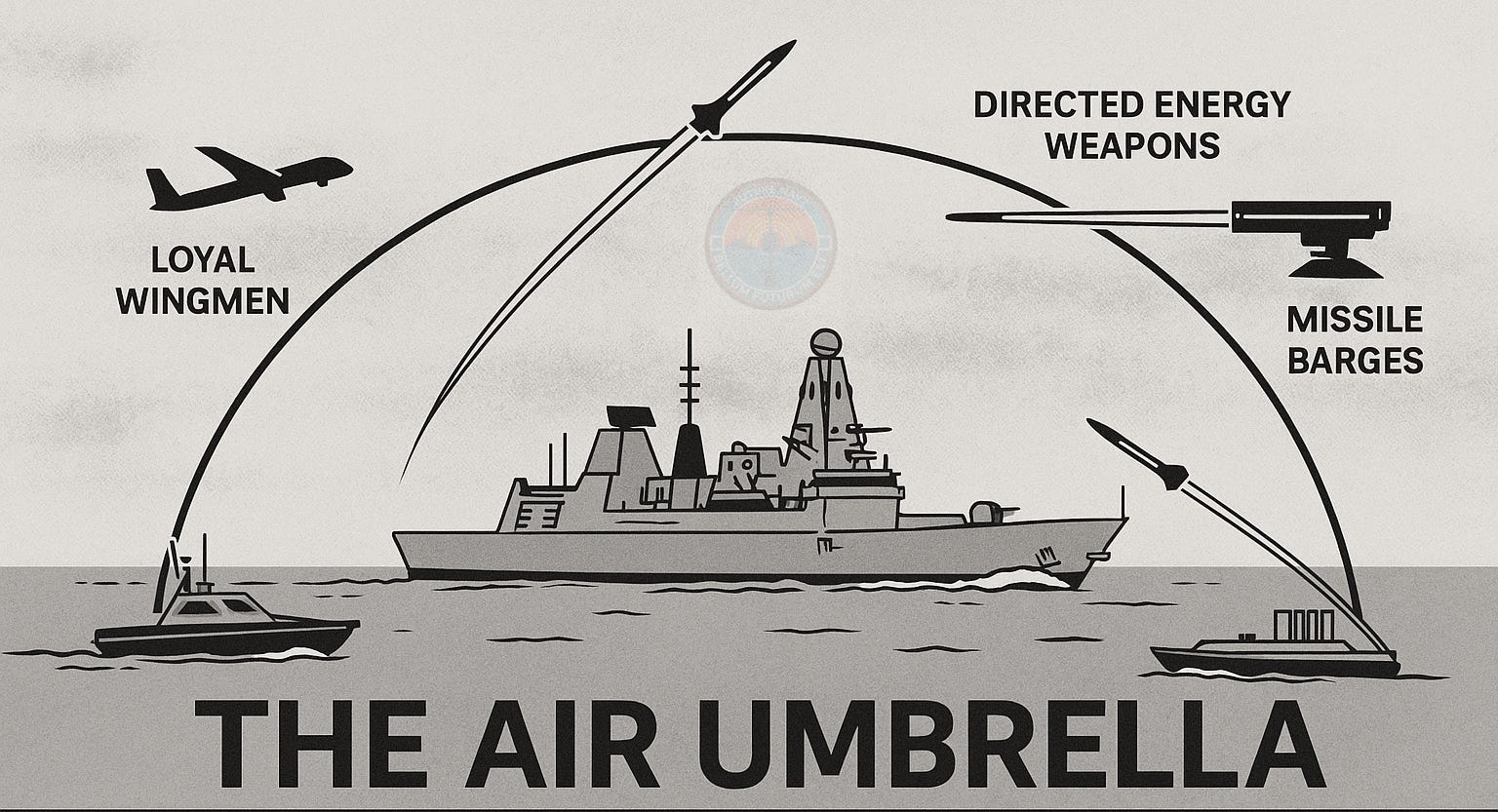
FADS is less a single weapon than a doctrine wrapped in hardware:
Missile barges & loyal wingmen
Large uncrewed surface vessels carrying interceptors or strike missiles, effectively providing “plug-in” magazine depth.
These USVs extend the reach of task groups, but shift the command problem: who authorises fires from an unmanned effector?
Directed energy weapons (DEWs)
The Dragonfire laser and successors promise cost-effective defence against drones and saturation threats.
DEWs invert traditional logistics: energy, not missiles, becomes the critical consumable. Commanders become power managers as well as tacticians.
Precision strike reach
Addressing the Red Sea dilemma: a destroyer that can intercept cannot simply watch strikes land ashore. FADS envisages distributed long-range strike, shifting deterrence from passive protection to active denial.
Automation and lean manning
Persistent RN recruiting pressure forces automation deeper into the force. AI shipmates move from optional assistants to essential watchkeepers.
Together, these pieces resemble Israel’s Iron Dome or the U.S. “Golden Dome” — but scaled for the maritime domain and fused into Britain’s “British-first” development pathway.
The command problem
The real test is not technological. It is human.
Warfare team adaptation: Ops Rooms built around Thales TACTICOS can already ingest AI aids, automate track evaluation, and present “intelligent prompts”. But warfare officers must re-learn the art of trust: when to believe the machine, when to challenge it, and how to fight across multiple semi-autonomous partners.
Damage control in the lean era: as the U.S. Littoral Combat Ship experience showed, reduced manning plus high automation creates dangerous frictions. Sensors misreport, sailors instinctively try to “verify by hand,” and policy lags behind technology. A loyal wingman with a magazine of interceptors is useless if commanders do not trust its battle damage reporting.
Authority and ethics: Who signs the firing order for a missile barge? How does a Commanding Officer exercise judgment when their “formation” now includes semi-autonomous partners? The Navy must evolve doctrine, Rules of Engagement, and training pipelines to answer these questions.
The CMS dimension
No air umbrella will work without a command system able to orchestrate it.
Thales TACTICOS is already entrenched in the RN through the Type 31, boasting an open architecture, workflow-driven HMI, and the ability to ingest AI-aided decision tools.
BAE Systems, by contrast, has historically been wedded to its proprietary CMS-1. Yet in both their subsea networking trials and FADS concepts, they are now emphasising a “re-architected” openness. The subtext is clear: if CMS-1 cannot evolve, it risks exclusion from the distributed fight.
This is more than a software tweak. It is an admission that command systems must shift from single-hull action information centres to fleet-level orchestration nodes, capable of directing loyal wingmen, missile barges, and directed-energy assets in parallel.
Sir Gwyn Jenkins’ horizon
The First Sea Lord has already set the direction. Within four years, he wants every crewed ship to deploy with uncrewed escorts, above, on, and below the waterline. That near-term push is about scaling innovation already in hand.
FADS is the longer-term horizon: the architecture into which those escorts will plug. In other words, FADS is the doctrinal end state toward which AI Shipmate’s leadership evolution must point.
Implications for command
Decision authority diffuses outward: commanders must delegate to AI shipmates, then retain ultimate sanction. This changes training; officers must be comfortable fighting through algorithmic partners, not just human subordinates.
Ops Rooms become orchestration hubs: less about fighting one ship, more about managing a mesh of crewed and uncrewed effectors, each with different latency, persistence and vulnerability.
Leadership culture must evolve: warfare teams must overcome instinctive mistrust of automation while retaining healthy scepticism. Doctrine must codify how to balance speed (machine recommendations) with judgment (human command).
Ethics and legitimacy: as FADS disperses firepower into loyal wingmen, public trust in AI-enabled warfare will hinge on transparency of decision pathways. Leaders must prepare for scrutiny not just from allies, but from Parliament and the public.
Closing thought
FADS is not simply a concept sketch from BAE Systems. It is the operational manifestation of the AI Shipmate debate. The Royal Navy’s future task groups will be judged not by the silhouette of a single destroyer, but by their ability to knit together ships, barges, drones and directed energy into one coherent umbrella.
The question is not whether Britain can build the pieces; industry is already demonstrating them. The question is whether the Navy can adapt its leadership, command culture, and doctrine fast enough to wield them.
The conclusion of AI Shipmate Part 3 poses this challenge: in the era of the air umbrella, can the Royal Navy effectively engage with the network rather than focusing solely on individual ships?