

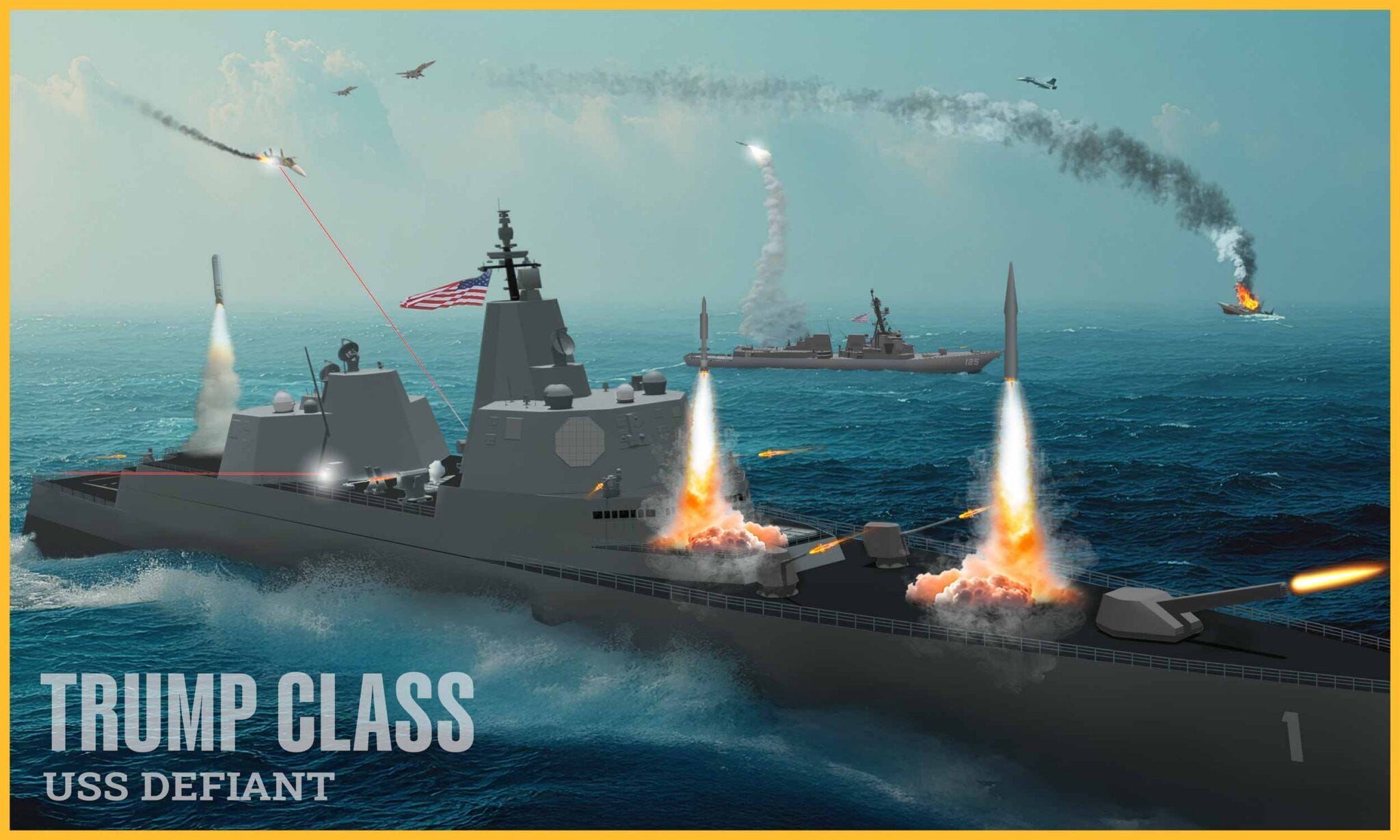
The idea of the battleship never quite disappears.
When strategic confidence weakens and uncertainty grows, large visible platforms regain their appeal. They are legible expressions of power. They suggest endurance, resolve, and mass in ways that distributed systems and software-defined forces struggle to communicate.
So take the idea seriously.
Assume a modern US battleship is built. Not a nostalgic replica, but a contemporary capital ship. Large displacement. Deep missile magazines. Extensive command facilities. Significant electrical margin. Designed to be the most formidable surface combatant afloat.
The interesting question is not whether it would be powerful. The question is how it would actually be used once physics, geography, and adversary behaviour are allowed to speak.
The governing constraint: ASW, noise, and detectability
Every discussion of large surface combatants eventually arrives here.
Big ships are noisy in multiple dimensions. Acoustically, they displace and disturb vast volumes of water. Electromagnetically, they radiate to support sensor, network, and command functions. Logistically, they generate predictable replenishment patterns. Operationally, they demand escorts that themselves create detectable movement.
In modern naval warfare, particularly in the North Atlantic and Western Pacific, anti-submarine warfare and persistent Intelligence, Surveillance, and Reconnaissance shape the battlespace before any missile is fired. Intelligence, Surveillance, and Reconnaissance (ISR) is the network of sensors, platforms, and analysis that allows a force to see, track, and understand an adversary continuously, often long before any weapon is used.
This imposes an immediate and unavoidable consequence.
A battleship cannot operate as a forward, leading platform in contested waters without becoming the dominant acoustic and targeting feature of the operating area.
That single fact forces a doctrinal shift. The ship must operate behind an outer ASW and ISR screen, with quieter, more expendable, and more numerous platforms forward. Its role becomes dependent rather than leading.
This is not a critique. It is the starting condition for everything that follows.
What the ship becomes in practice
Once pushed back by ASW and detectability realities, the battleship settles into a narrower but coherent role set.
A rear-area missile magazine
Deep magazines matter most when sustained fires are required over time. The ship becomes a source of volume, not immediacy. It delivers the weight of fire based on the targeting provided by others.
A command and integration node
Large hulls buy space, power, and people. In complex operations, this matters. The ship can host joint, coalition, and multi-domain coordination without displacing other mission sets.
A political and strategic signal
Visibility is not incidental. The ship is a powerful ship. That signalling value reassures allies and deters adversaries, but it also raises the political cost of loss or damage.
Each of these roles is valid.
Each also increases reliance on the surrounding force.
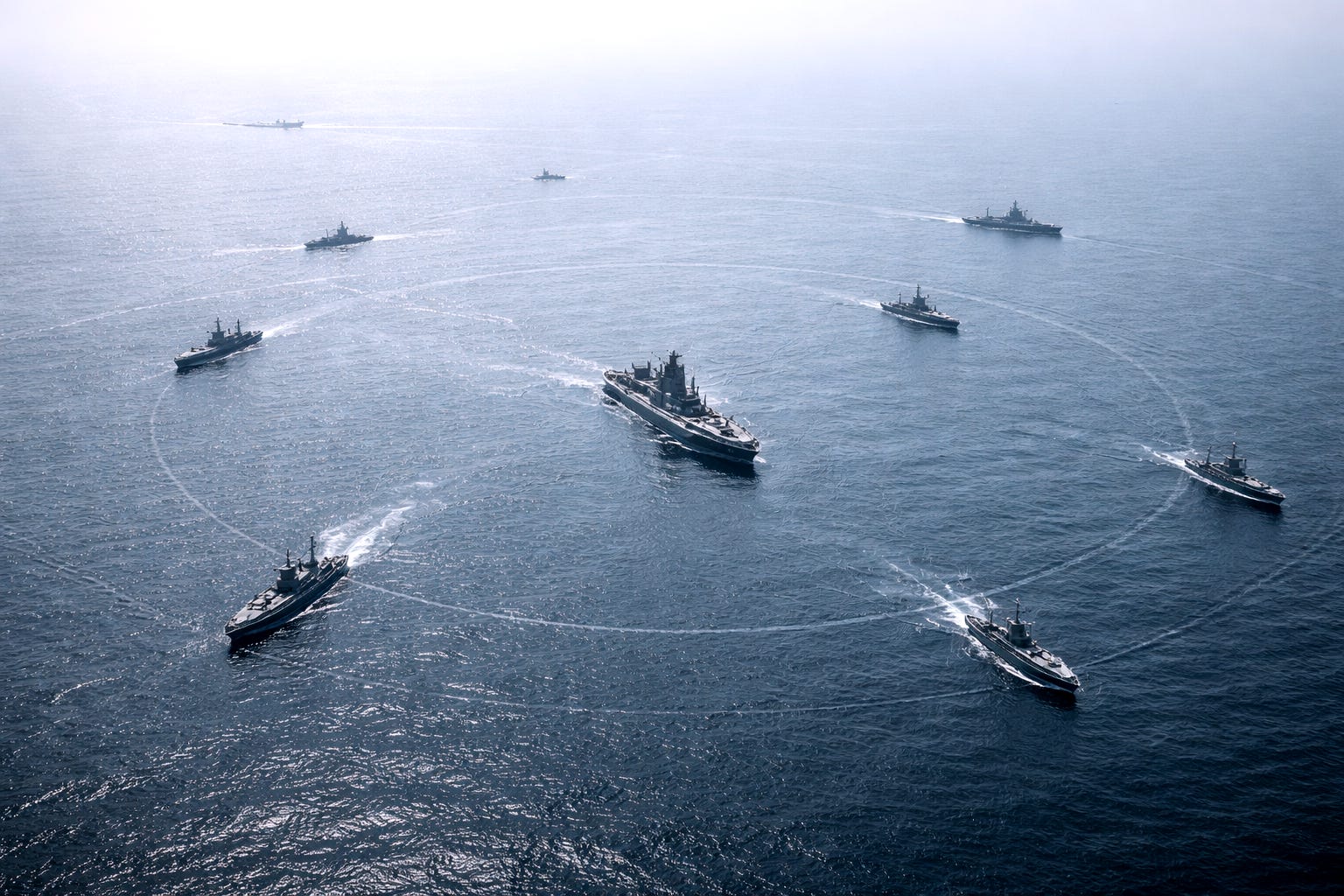
Scenario 1: Caribbean and Venezuela-style pressure operations
In a sanctions-enforcement or regional-coercion scenario, the battleship operates in its most forgiving environment.
Threat levels are limited. Sea space is manageable. The mission is endurance, coordination, and presence rather than high-end combat.
Here, the ship functions as:
A joint and interagency command platform
A visible anchor for sustained US presence.
A defensive air and ISR coordination hub
Escort requirements remain modest:
One air-defence destroyer for redundancy and layered coverage
One multi-role frigate for surface and limited subsurface awareness
Subsurface assets are available but not permanently attached.
Heavy reliance on aviation and Coast Guard integration
In this environment, the ship appears effective. Nothing fundamentally challenges its survivability. Nothing forces difficult trade-offs.
This matters because success in permissive environments often disguises fragility in contested ones.
Scenario 2: North Atlantic deterrence and reinforcement
Move the same ship into the North Atlantic, and the logic tightens sharply. This is a battlespace dominated by submarines, long-range strike systems, weather, and distance. The ship’s size no longer reassures itself. It attracts attention.
ASW reality becomes the governing factor.
To avoid becoming the dominant acoustic contact, the ship must remain behind a layered screen. That screen is not optional. To operate credibly, the battleship now requires:
Two submarines in support, one forward on the threat axis and one manoeuvring
At least two dedicated air-defence escorts to manage long-range strike risk
Continuous ASW frigate coverage with towed arrays
Secure and survivable replenishment at sea
At this point, the ship’s contribution is real. It adds missile depth, command capacity, and endurance.
It also consumes a disproportionate share of escort capacity.
The trade-off is structural. Every escort committed to protecting the battleship is an escort not available for distributed ASW, convoy protection, or independent tasking.
Scenario 3: Taiwan and sustained grey-zone pressure
This is the most demanding environment and the clearest stress test. A Taiwan harassment campaign is not about a decisive battle. It is about shaping behaviour through pressure, ambiguity, and persistence. The opposing system, led by the People’s Liberation Army Navy, integrates space, cyber, air, surface, subsurface, and information effects.
In this environment, being continuously tracked is more damaging than being attacked.
A battleship’s size, emissions, and escort footprint make concealment impossible. Its movements would be catalogued. Its logistics are mapped. Its presence normalised. Operationally, it could only operate well east of Taiwan, outside the first island chain, as a rear-area command and missile node.
Even there, survivability demands escalate:
Three or more dedicated air-defence destroyers
Multiple submarines operating forward and on the flanks
Dense unmanned decoy and ISR layers
Continuous logistics protection
China would not need to strike the ship. Demonstrating that it can be tracked, shadowed, and pressured would be sufficient to constrain its use.
In a grey-zone campaign, a platform that cannot be risked forward becomes a tool of reassurance rather than leverage.
Sustainment, tempo, and the hidden cost of mass
Beyond combat survivability lies a quieter constraint: sustainment. Large ships burn readiness quickly. They demand maintenance windows, crew depth, and industrial support. Their escorts do the same. High-tempo deployment of a capital ship, therefore, pulls disproportionately on fleet readiness.
This matters because modern competition is about time on station and persistence, not short surges of power.
A force that looks formidable on day one but cannot be sustained at scale becomes predictable and therefore manageable by an adversary.
The force-structure question
Across all scenarios, a consistent pattern emerges.
The battleship is never just a ship.
It is a system anchor that pulls escorts, submarines, logistics, ISR, and political attention towards itself. Where the threat is low, this looks acceptable. Where the threat is intelligent and persistent, it becomes constraining.
None of this invalidates the concept. But it does mean the ship’s value cannot be judged solely by its capabilities. It must be judged by what the wider force can afford to provide around it, repeatedly, under pressure, and without distorting everything else.
A final observation
Large platforms do not fail because they are weak. They fail when the system around them cannot support them without becoming brittle.
If such a ship were built, it would be powerful.
It would also be demanding.
What that trade-off is worth is left deliberately unanswered.