

Argentina is rearming. Oil is moving from prospect to production in the waters around the Falkland Islands. President Javier Milei has hardened Argentina’s sovereignty campaign. And in Washington, the second Trump administration is asserting a much more muscular view of American primacy in the Western Hemisphere. Put those developments together, and it is easy to construct an alarming headline:
Could Argentina take the Falklands again?
That is the wrong question.
Argentina is not currently rebuilding the force that invaded the islands in 1982. Britain has not abandoned their defence. No evidence suggests another invasion is imminent. But something important is changing in the South Atlantic.
The assumptions that have underpinned Falklands deterrence for more than four decades are becoming less comfortable. Argentina is slowly recovering military capabilities it had lost. Offshore oil is creating new economic interests and new vulnerabilities. American policy towards the hemisphere is becoming less predictable. At the same time, Britain’s armed forces are being asked to maintain commitments across Europe, the North Atlantic, the Indo-Pacific, and the Middle East with limited resources.
None of these developments individually constitutes a Falklands crisis. Together, they deserve attention. And the lesson for Britain should not be to prepare to fight the Falklands War again.
It should be to ensure that there is never a reason to do so.
What has actually changed?
It is worth separating the facts from some of the more excitable commentary. Five developments have materially changed the context around the Falklands since 2025.
Argentina has begun rebuilding credible fast-jet capability.
The first six of 24 former Danish F-16A/B aircraft arrived in December 2025. Further deliveries are expected through 2028, supported by training, modern air-to-air weapons and precision-guided munitions.
Argentina’s wider military recapitalisation is gathering pace.
Buenos Aires has agreed a programme covering up to 235 Stryker armoured vehicles and continues to explore options for rebuilding its submarine force. These programmes are significant, but much of the capability remains prospective rather than operational.
Sea Lion has moved from prospect to project.
Final Investment Decision was taken in late 2025. Drilling is expected to begin in 2027, with first oil targeted for the first quarter of 2028. That turns hydrocarbons around the islands into a real strategic and economic issue rather than a distant possibility.
Milei has hardened Argentina’s political approach.
Buenos Aires has threatened tougher measures against companies involved in Falklands oil development and is placing greater emphasis on the South Atlantic within its broader defence and sovereignty policy.
Washington has introduced new uncertainty.
The Trump administration has embraced a more assertive interpretation of American primacy in the Western Hemisphere, sometimes described within the administration itself as the “Donroe Doctrine”. President Trump has also said the US position on the Falklands is under review.
None of those facts means war is coming. But taken together, they mean the strategic environment is no longer static.
The danger of looking back to 1982.
Inevitably, this is personal for me.
On 21 May 1982, I was aboard HMS Ardent in Falkland Sound when she came under sustained Argentine air attack. Twenty-two of my shipmates were killed. The Falklands War has therefore never been an abstract military campaign to me. But that is precisely why I am wary of using 1982 as the template for viewing every new development in Argentina.
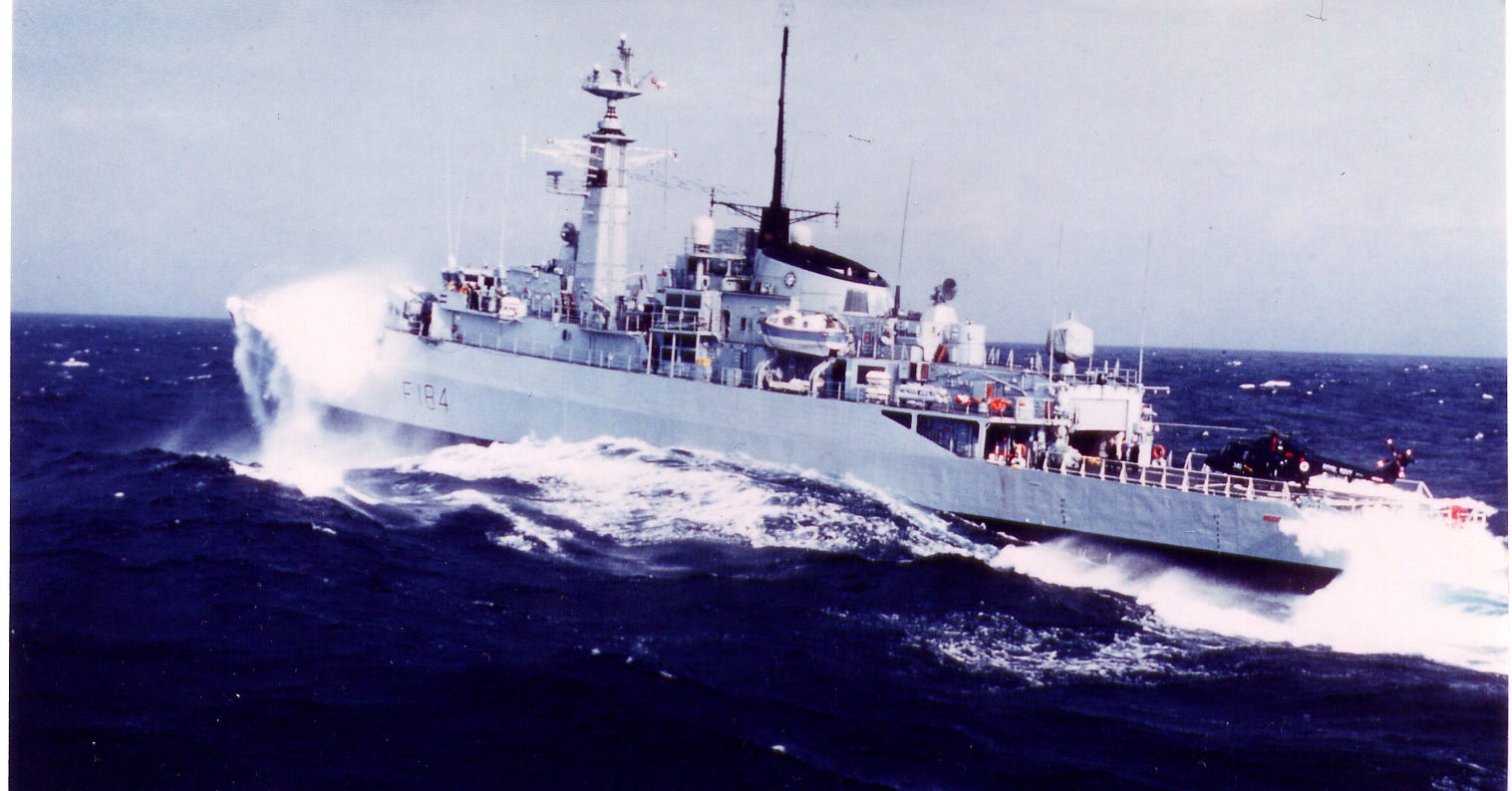
The Argentine armed forces of 1982 were formidable by regional standards. Argentina possessed a sizeable combat air force, an aircraft carrier, submarines, modern surface combatants, amphibious shipping and the ability to put troops ashore. Britain, meanwhile, had no permanent fighter force on the islands and nothing resembling today’s military infrastructure at Mount Pleasant.
The strategic problem today is fundamentally different.
Argentina has spent decades suffering from declining defence investment and lost capabilities. Its submarine force is currently non-operational. Its navy cannot reproduce the amphibious operation of April 1982. Much of its equipment requires modernisation.
That matters when assessing the headlines surrounding Argentina’s current rearmament. It is a recovery from a very low base. But recovery is nevertheless taking place.
Argentina gets its fast jets back.
The most visible symbol is the F-16.
Argentina has purchased 24 former Danish F-16A/B fighters. The first six arrived in December 2025, with further deliveries expected through 2028. The significance goes beyond simply acquiring another aircraft type. For years Argentina effectively lacked a credible modern supersonic fighter capability. The F-16 programme begins to reverse that.
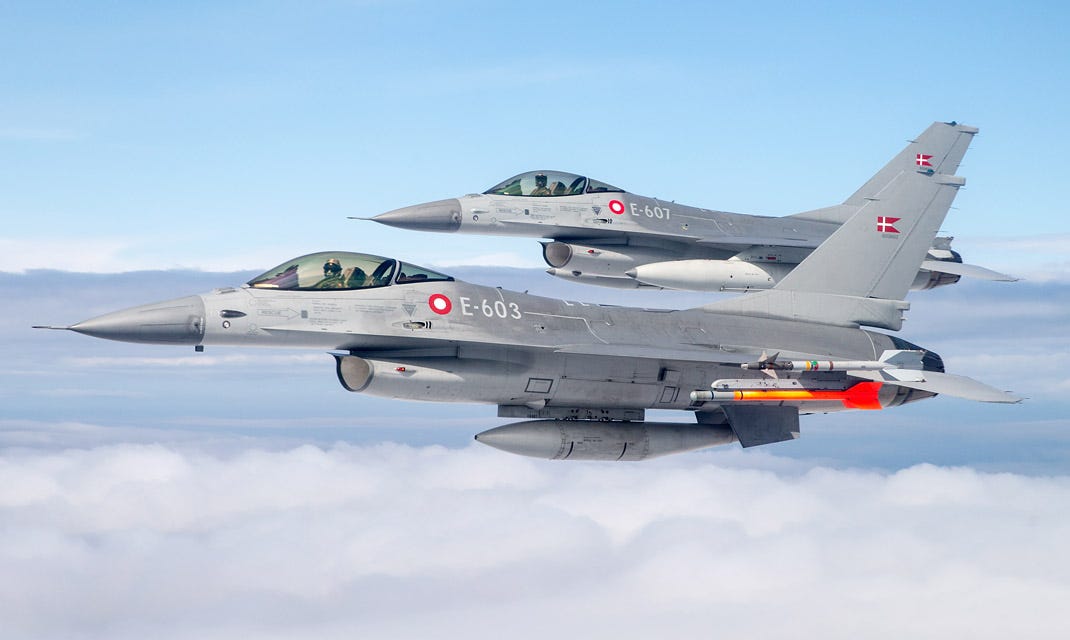
The associated American package includes training, support, and modern air-to-air weapons, including AIM-120 AMRAAM, plus precision-guided munitions. As aircraft, pilots, weapons, and support infrastructure mature, Argentina will regain a capability British planners cannot simply ignore.
But perspective matters. Twenty-four F-16s do not equal another Falklands War.
Generating combat power over the South Atlantic requires much more than owning fighters. It requires trained crews, serviceability, weapons stocks, intelligence, surveillance, command and control, tanker support, maritime forces, logistics and the ability to sustain operations over considerable distances.
Argentina also does not currently possess the naval force required to seize and sustain the islands. Plans to restore its submarine capability are worth watching. France’s Scorpène has been under consideration, although financing and competing options remain unresolved. Argentina has also embarked on wider army modernisation, including an agreement covering up to 235 Stryker armoured vehicles.
These programmes tell us something important about the direction of travel. They do not tell us that Argentina is preparing an invasion.
Military modernisation and military intent are very different. We should be careful not to confuse the two.
The oil changes the calculation.
The most consequential development in the South Atlantic is not an F-16 at all.
It is Sea Lion.
After years in which Falklands hydrocarbons seemed perpetually in the future, the Sea Lion oil development has passed Final Investment Decision. Development activity is now under way, drilling is expected to begin in 2027, and first oil is targeted for the first quarter of 2028.
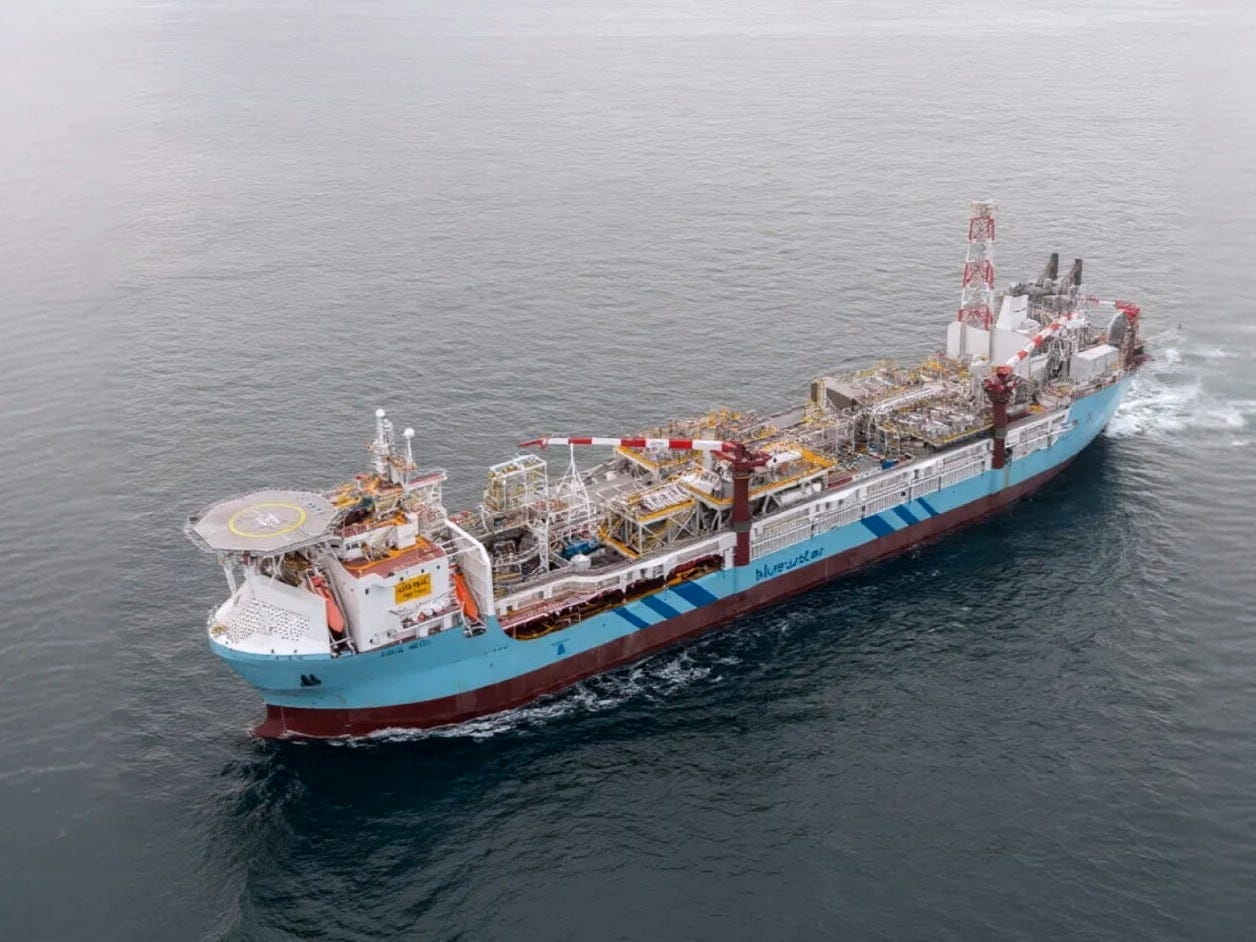
That changes the sovereignty dispute. Oil gives the islands the prospect of significant long-term economic activity. It also creates fixed infrastructure, international investment, shipping movements, supply chains and commercial relationships that Argentina can seek to challenge.
Buenos Aires already regards hydrocarbon development around the Falklands as illegal. Milei has now threatened tougher sanctions against companies involved. This is where the discussion becomes more interesting than another invasion scenario.
Argentina does not have to land troops at Stanley to create difficulties for Britain.
It can challenge companies legally. It can sanction directors and investors. It can place pressure on regional ports and suppliers. It can contest maritime activity diplomatically. It can attempt to increase the insurance and commercial costs of operating around the islands.
In a more confrontational future environment, offshore infrastructure itself becomes something Britain must monitor and protect. Sea Lion therefore changes more than the Falklands’ economics.
It potentially expands the area Britain must deter others from interfering with.
Enter the “Donroe Doctrine”
Another variable would have seemed unlikely only a few years ago.
Washington.
The Trump administration has increasingly framed the Western Hemisphere through an assertive reinterpretation of the Monroe Doctrine. The phrase “Donroe Doctrine”, originally journalistic shorthand, has subsequently been used within the administration itself.

Behind the label is a serious idea. The United States intends to reassert primacy in the Americas and resist strategic influence from powers such as China and Russia.
For Britain, the key question is where that leaves a European state administering territory in the South Atlantic that Argentina claims. Here, historical accuracy matters.
The United States has not traditionally recognised British sovereignty over the Falkland Islands. Its longstanding position has essentially recognised British administration while remaining neutral over the competing sovereignty claims.
That distinction mattered in 1982.
Washington attempted to mediate between Britain and Argentina before ultimately providing Britain with substantial practical assistance once diplomacy failed. The new uncertainty, therefore, is not that America might suddenly stop recognising British sovereignty. It never formally did.
The question is whether Washington would continue to distinguish between neutrality over sovereignty and opposition to Argentine coercion. That question became more significant when President Trump said recently that the American position on the islands was under review.
It would be wrong to leap from that statement to the conclusion that Washington is preparing to support Argentina’s claim. There is no evidence for that. But uncertainty now exists where Britain would prefer certainty.
President Milei has cultivated a close political relationship with Trump and has spoken of changing circumstances surrounding Argentina’s claim. Again, none of this means America is about to abandon Britain over the Falklands. But deterrence depends partly upon what potential adversaries believe.
Ambiguity therefore matters.
Britain’s position is stronger than some headlines suggest.
The other side of the argument also needs perspective. There is a growing tendency to take every current difficulty facing Britain’s armed forces and conclude that the Falklands are therefore undefended. That is too simplistic.
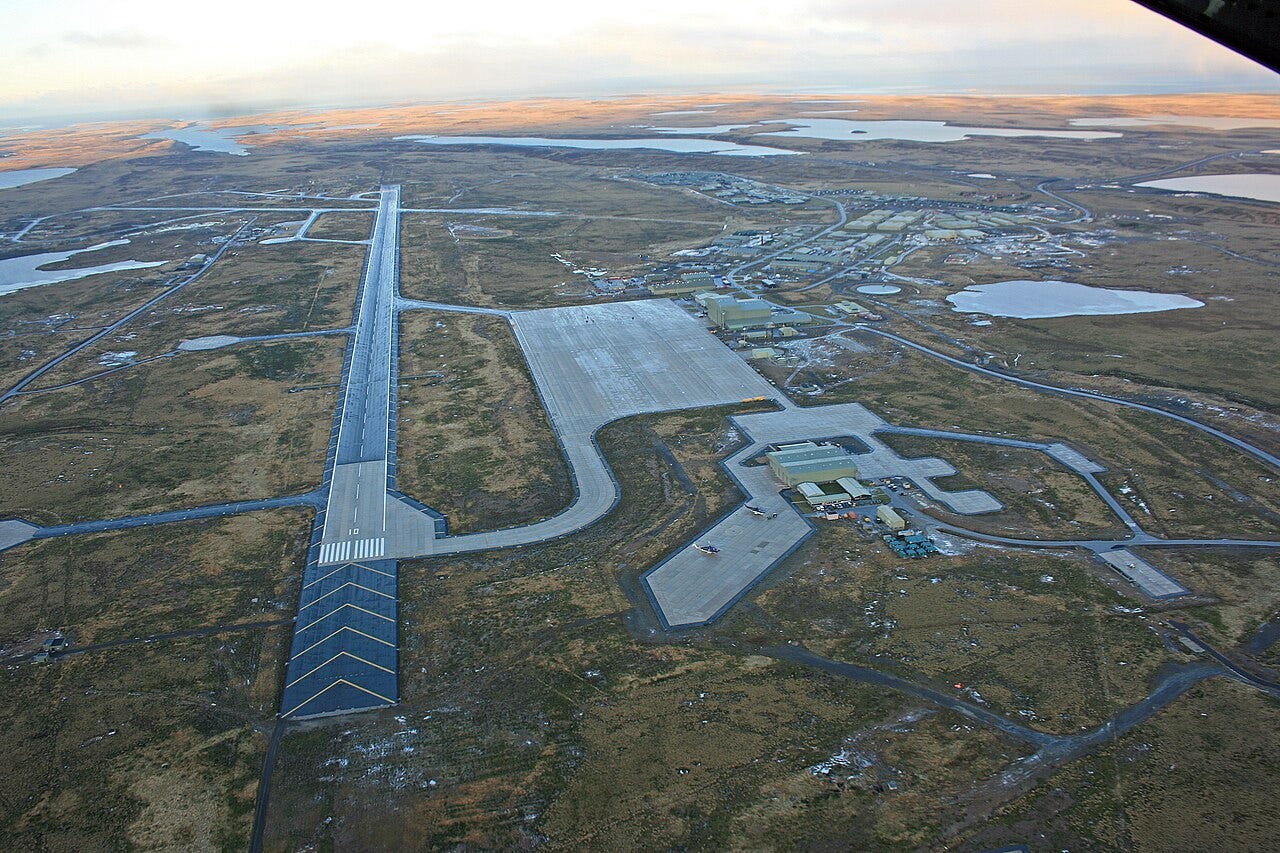
The fundamental difference between 1982 and today is that Britain does not plan to arrive after an invasion. It is already there. RAF Mount Pleasant transformed the strategic equation after the war.
Typhoon fighters provide permanent air defence. The islands maintain ground forces, air defence, surveillance, and supporting infrastructure. Britain retains a maritime presence in the South Atlantic and has robust plans for reinforcement.
The Ministry of Defence has repeatedly stated during 2026 that the defensive posture is kept under review, including against developments in drones and long-range weapons, and remains appropriately scaled.
Dismissing that assessment would be unwise. Equally, it would be unwise not to test the assumptions behind it.
Britain’s wider armed forces are stretched.
The Royal Navy has well-documented availability and personnel pressures. Traditional amphibious capability is being transformed. The Royal Fleet Auxiliary faces its own challenges. Competing demands exist in the North Atlantic, Mediterranean, Gulf and Indo-Pacific.
A Falklands reinforcement operation would also span approximately 8,000 miles of ocean. So the relevant question is not whether Britain possesses enough ships on a particular Monday morning to recreate the 1982 Task Force. It is:
Can Britain keep Mount Pleasant operational, supplied, connected and sufficiently well defended that no opponent can create a realistic opportunity to challenge the islands?
That is a very different test.
Mount Pleasant is the centre of gravity.
The Falklands defence problem is therefore increasingly one of resilience.
Aircraft need fuel.
Weapons need storage.
Runways need to remain usable.
Sensors need power.
Communications need to survive disruption.
Ships and aircraft need maintenance.
Personnel need food, accommodation and medical support.
And all of it sits at the end of one of Britain’s longest military supply chains. This is familiar territory for Future Navy.
We have discussed autonomous vessels, software-defined warships and artificial intelligence extensively. But none of those technologies eliminates logistics.
The last mile still matters.
Indeed, the further Britain moves towards distributed and autonomous forces, the more important the infrastructure connecting them becomes. The Falklands provide an almost perfect example.
A handful of additional autonomous systems around the islands could significantly increase surveillance without requiring hundreds of additional personnel.
Long-endurance uncrewed aircraft could extend the surveillance picture.
Uncrewed surface vessels could patrol maritime approaches and offshore infrastructure.
Underwater vehicles and distributed sensors could help monitor submarine activity.
Space-based surveillance could provide persistent awareness of Argentine military movements.
AI-supported systems could fuse those feeds into a much richer operating picture.
None of these needs to carry weapons to be valuable. Their first purpose would be to make surprise increasingly difficult.
The next Falklands crisis may begin in the grey zone.
This is where concentrating on another Argentine invasion becomes most misleading. Imagine a future crisis in which nobody initially fires a shot.
An unidentified drone appears repeatedly near offshore oil infrastructure.
GPS interference affects maritime operations.
Cyber attacks disrupt communications or logistics.
An Argentine survey vessel operates close to disputed waters.
Commercial companies face escalating legal action.
Regional ports come under political pressure not to support Falklands-bound vessels.
Military aircraft conduct increasingly assertive patrols.
Social media fills with competing claims about an incident at sea.
A future Argentine submarine leaves an Argentine naval base and disappears beneath the South Atlantic.
None of these actions necessarily constitutes war. Together they could create a significant British military problem. The requirement would be to understand what was happening, attribute it correctly and respond proportionately without creating the escalation an opponent might be seeking.
That requires more than having a frigate available. It requires persistent situational awareness.
And that is precisely what the emerging Hybrid Navy should offer.
A Hybrid Falklands defence.
The First Sea Lord’s vision of a Hybrid Navy is usually discussed in the context of high-end warfighting: crewed warships operating alongside autonomous systems, increasing mass without proportionately increasing personnel. The Falklands suggest another use.
Persistent deterrence.
Imagine a South Atlantic surveillance architecture built around Mount Pleasant rather than simply a collection of individual platforms.
Typhoon remains the high-end combat element.
A Royal Navy vessel provides presence and maritime command.
But a much larger network surrounds them.
Long-endurance UAVs maintain surveillance beyond the islands.
USVs monitor shipping and offshore infrastructure.
UUVs periodically survey important approaches and seabed infrastructure.
Commercial satellite data supplements military ISR.
Passive sensors provide additional warning.
All of that information is fused into a common operating picture shared between the Falklands, Northwood and deployed forces.
In a crisis, additional autonomous systems can be flown or shipped south much faster than traditional warships can be generated and deployed. This does not replace people. Nor does it remove the need for ships, aircraft or weapons.
It makes the relatively small force already in the South Atlantic much harder to surprise. That is exactly the sort of task at which autonomy should excel.
But sensors do not solve the logistics problem.
There is a danger here too. A Falklands version of the Hybrid Navy cannot become another technology demonstration. The difficult questions remain decidedly physical.
How much aviation fuel is stored on the islands?
How long can air operations continue if resupply is disrupted?
How quickly can a damaged runway be repaired?
How much ammunition is pre-positioned?
Are there sufficient spares for sustained Typhoon operations?
How resilient are satellite and undersea communications?
Can autonomous systems be maintained locally?
How much dependence remains upon civilian contractors and commercial supply chains?
How quickly could Britain reinforce the islands if warning time collapsed from weeks to days?
The answers to many of those questions are understandably not public. They nevertheless matter more than simply counting Argentine F-16s against British Typhoons.
Deterrence is ultimately a calculation made in somebody else’s capital. The objective is to ensure that calculation always produces the same answer:
It won’t work.
Ascension still matters.
There is another dot on the South Atlantic map that should not be overlooked: Ascension Island.
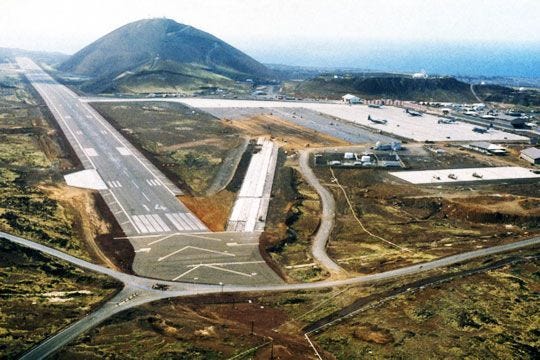
Its importance in 1982 is well understood, but its relevance has not disappeared. Any sustained reinforcement of the Falklands still depends upon infrastructure, staging, airlift, tanker support and access across enormous distances.
In a future crisis, Ascension could again become critical to moving people, aircraft, stores and potentially autonomous systems south. That makes resilience there part of Falklands deterrence too.
The defence of the islands should therefore not be considered simply as a ring drawn around East Falkland. It is a network extending north through Ascension and ultimately back to Britain. Break enough links in that network, and the forces at Mount Pleasant become progressively less useful. Protect those links and the strategic problem facing Argentina becomes much harder.
What Argentina sees matters.
It is also worth looking at this from Buenos Aires. Argentina maintains a sovereignty claim which enjoys broad political support across its domestic political spectrum. Milei has not invented the dispute, even if his approach and his relationship with Washington have changed how it is presented.
From an Argentine perspective, Britain’s military presence and exploitation of natural resources around the islands reinforce a situation it regards as illegitimate. That does not make the Argentine claim correct. Nor does it override the Falkland Islanders’ clearly expressed wish to remain British. But understanding the other side’s perspective is part of deterrence.
Argentina may reasonably conclude that its relative military position will improve over the next decade as F-16 capability matures and other modernisation programmes progress. It may also believe that Britain’s global commitments will continue to stretch its armed forces. And it may see an American administration increasingly focused on hemispheric politics as creating diplomatic opportunities that did not previously exist.
Britain should not panic about those calculations. It should ensure they never add up to an attractive opportunity.
Deterrence before the Task Force.
Britain has an understandable tendency to measure Falklands security against the extraordinary achievement of 1982.
Could we still send a Task Force?
How many escorts could we generate?
Could the carriers operate that far south?
Where are the amphibious ships?
Those are legitimate questions in the extreme case where deterrence has already failed. But they are not where I would start.
The purpose of Britain’s post-1982 Falklands strategy was precisely to avoid having to conduct another Operation CORPORATE.
That remains the objective.
The Falklands of the 2030s should therefore be defended through persistent awareness, resilient infrastructure, credible air power, sufficient stocks, protected logistics and the ability to reinforce early.
Autonomous systems can contribute substantially to that architecture. So can AI, but neither replaces the fundamentals.
Fuel still has to reach Mount Pleasant.
Aircraft still have to fly.
Weapons still have to work.
Runways still have to be repaired.
Ships still have to be sustained.
And ultimately people still have to make decisions in circumstances where the distinction between provocation, coercion and armed attack may be deliberately unclear.
Not 1982.
I have no desire to see another Falklands War. Those of us who were there understand better than most what the phrase “military option” ultimately means. That is also why I think some of the current commentary risks missing the point.
Argentina’s F-16s matter.
Milei’s rhetoric matters.
Sea Lion matters.
The changing politics of Washington matter.
Britain’s stretched military resources matter.
But none of them, individually or collectively, demonstrate that another Argentine invasion is imminent. What they demonstrate is that the strategic environment around the Falklands is changing. Britain has time to respond. The right response is neither alarmism nor complacency.
It is deterrence.
And in the South Atlantic of the 2030s, deterrence may increasingly depend on something we have discussed throughout the Future Navy series: the ability to connect ships, aircraft, autonomous systems, sensors, infrastructure, logistics, and people into a force more capable than the sum of its individual platforms.
In 1982, Britain had to retake the Falkland Islands. The measure of success for the Future Navy is much simpler.
Make sure we never have to do it again.
I am poorly placed to discuss the military side, but I can tell you for a fact that in 1982, there was vigorous debate as to which side the US should support--if any. SECSTATE Schultz strongly advocated for a pro-UK posture while SECDEF Weinberger advocated either neutrality--a de facto pro-Argentine position--or open support of the Argentine. The situation was complicated, not least because the post-Peron military junta then in power had provided significant support to the American effort to dislodge the Sandinistas in Nicaragua.
Ultimately President Reagan came down on the side of support for Britain, but there was, of course, a personal as well as a political dimension to that: while it was true that Britain was our firmest and fastest ally, I expect that Mrs. Thatcher's genuine friendship with Ronnie may have influenced the outcome as well.
Of course, once that happened, we lost all possibility of continuing Argentine support for the covert activities against the Sandinistas, which in turn had numerous ripple effects--not least being the current situation in Nicaragua and the very real possibility of their once again becoming a destabilizing influence in Central America.
I only make these points because I have observed that many Brits with whom I discuss this--including several personal friends--completely dismiss the idea--indeed are insulted--that the US would ever have sided with the Argies.
Don't fall into the same trap. Hemispheric security is very important to this administration and the current British government has already pulled the rug out from under us over the Chagos Islands. Indeed from what I understand they have completely ignored the express wishes of the Chagossians themselves, who from what I've read have no desire to become subjects of the Seychelles.
Like you, I don't believe it will ever come to blows. But not because the Argies will be deterred by what's left of the British Lion's forces. Rather, I believe the British government will come to some "compromise" arrangement with the Argentine which will supersede the will of the Falklanders.
Brings back memories. Part of my AOR in the late 80s was Denmark. The Danes couldn’t produce enough pilots for their F-16s so the U.S. loaned them some. I was tasked with supporting those pilots. Bottom line is there’s probably not many hours on those Danish F-16 airframes.