

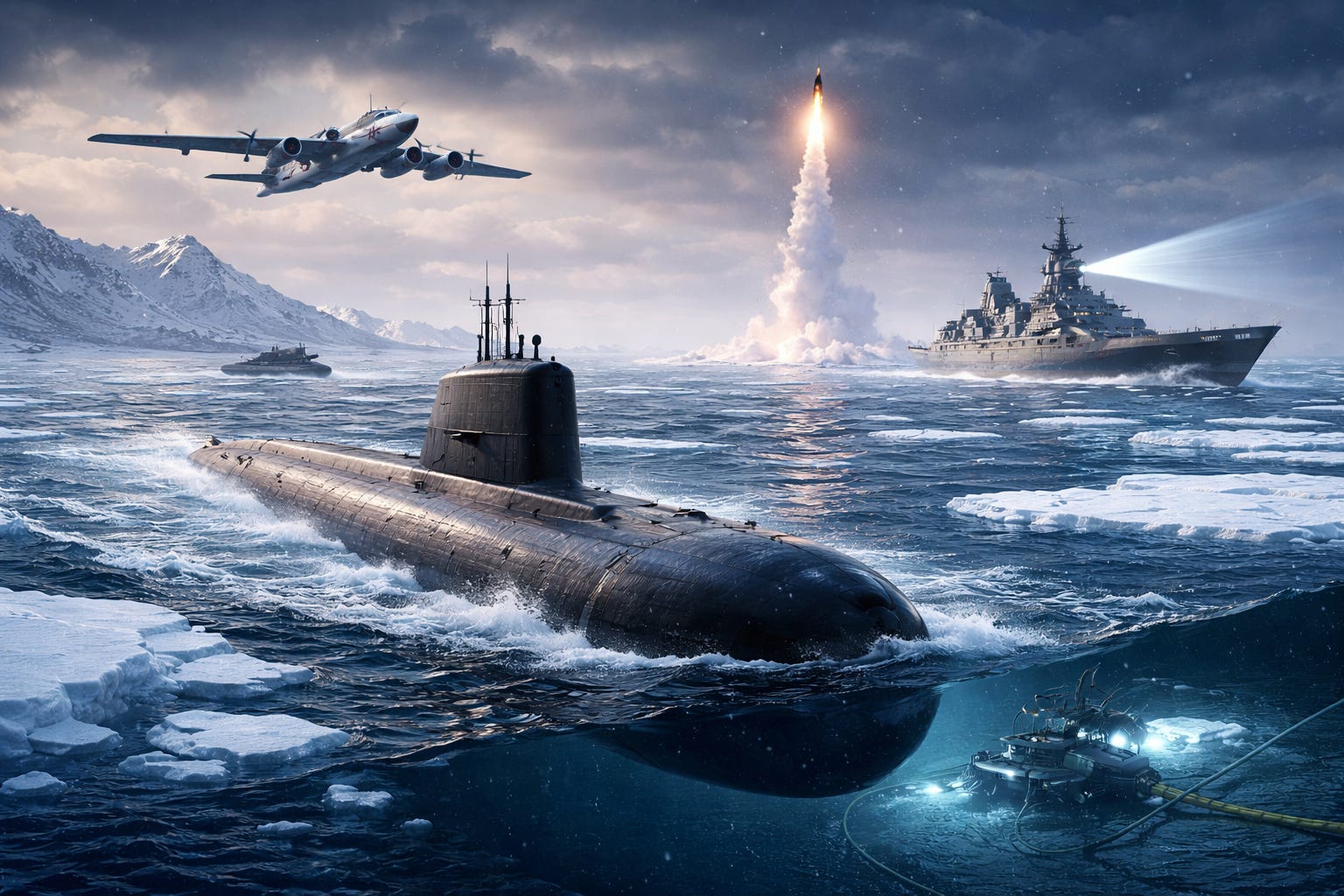
Moscow’s Perspective: The Bastion as a Planning Constraint Rather Than a Barrier
The Atlantic Bastion is one of the most consequential maritime ideas to emerge from the UK’s 2025 Strategic Defence Review. In British and NATO discourse, it is framed as a layered anti-submarine warfare construct: a network of sensors, uncrewed systems, aircraft, surface combatants, and submarines designed to restore undersea awareness across the North Atlantic, protect the UK’s deterrent, and secure critical seabed infrastructure.
While this framing is accurate, it remains incomplete.
From the Russian perspective, the Atlantic Bastion is neither an impenetrable barrier nor a significant deterrent. Instead, it is viewed as a planning constraint—a system that complicates operational timelines, exposes strategic intent, and necessitates early decision-making, but does not yet restrict freedom of action. Recognising this distinction is important, as maritime deterrence has historically focused on shaping adversary behaviour under pressure rather than achieving complete impermeability.
How Russia Thinks About the Atlantic
Russian naval strategy does not treat the Atlantic as a symmetrical battlespace. It divides the maritime domain into functional zones: coastal defence, near seas, far seas, and the global ocean. The North Atlantic and Norwegian Sea sit firmly in the far seas category, where Russia does not expect to achieve sea control. Instead, its objective is temporary sea denial and disruption.
In Russian doctrine, the navy does not need to win decisively. It needs to not lose quickly. Time, distraction, and escalation leverage are success metrics.
This logic informs Moscow’s assessment of the Atlantic Bastion. Rather than viewing it as a permanent barrier, Russian strategists interpret it as an effort to restore Western undersea transparency in a region Russia considers inherently contested.
Detection Is Assumed, Not Feared
A core Western assumption is that persistent detection contributes directly to deterrence. Russian planners do not fully share that belief.
Detection in the Norwegian Sea is already anticipated. During the Cold War, Soviet submariners expected detection at maritime choke points and planned their operations accordingly. This mindset endures. From Moscow’s perspective, early detection is tolerable if it compels NATO to deploy limited high-end anti-submarine warfare (ASW) assets prematurely, diverts US and UK submarines away from other operational theatres, and increases ambiguity regarding which contacts constitute genuine threats.
In this context, the Atlantic Bastion generates as much operational noise as it does clarity. The proliferation of sensors results in more tracks, increased data volume, and a greater burden on command structures. Detection by itself does not deter; rather, it diverts attention and resources.
Surge Beats Persistence
Russian operational planning emphasises surge operations over sustained endurance. The primary objective is not indefinite stealth, but rather to exploit the initial phase of a crisis, when political hesitation, legal uncertainty, and escalation management limit Western responses.
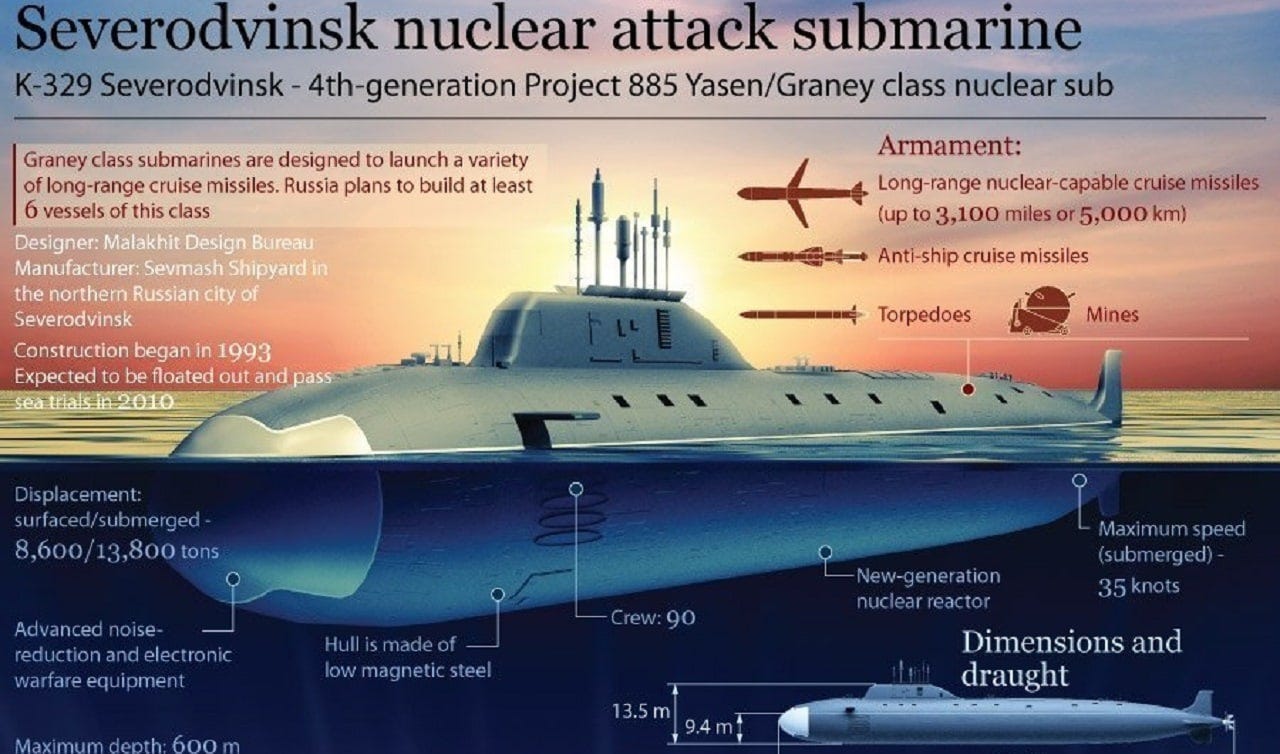
This rationale underpins three probable Russian approaches: conducting a pre-hostility surge of Yasen-class SSGNs and SSNs into the Atlantic, employing speed and depth to evade continuous tracking, and disrupting NATO ASW forces by presenting multiple simultaneous operational dilemmas.
Consequently, the Atlantic Bastion is regarded as a temporary obstacle rather than a permanent barrier.
Arctic and Under-Ice Bypass
A prominent Russian countermeasure to a GIUK-focused Bastion is to circumvent it entirely.
Russia has made significant investments in Arctic under-ice operations. Recent Northern Fleet exercises have demonstrated long-range submerged transits beneath the ice cap, including strategic ballistic missile submarine (SSBN) movements from the Barents Sea to the Pacific. The Arctic is not considered a sanctuary, but rather a manoeuvring space.
If the Bastion remains geographically constrained, Russia can utilise the polar front as acoustic cover, thereby bypassing the Norwegian Sea sensor grid. For this reason, Russian planners consider a Norwegian Sea-centric Bastion predictable. In their assessment, operational depth is more significant than sensor density.
Bastion as Intelligence
An important and often overlooked consideration emerges. From Moscow’s perspective, the Atlantic Bastion is valuable not only for its operational effects but also for the intelligence it provides. It reveals areas where NATO’s presence is limited, identifies genuinely high-value assets, and highlights the West’s continued reliance on a small number of advanced platforms.
In effect, the Bastion functions as a diagnostic tool. It demonstrates how NATO operates under pressure, allocates resources, and transitions from detection to decision-making.
Where Russia Sees Weakness
Russian analysts acknowledge the significance of the Atlantic Bastion, yet they also recognise its limitations.
First, deterrence by denial alone is insufficient. Russian doctrine presumes that sea control is always temporary and contested. Deterrence by denial, if not accompanied by a credible threat of punishment, is considered incomplete. Second, the Bastion’s capacity for conventional punishment is limited. A system that detects but cannot impose costs is regarded as an early warning mechanism rather than a true deterrent. Russia anticipates Western reluctance to escalate from detection to destruction, especially below the threshold of open conflict.
Third, geographic compression presents a vulnerability. A Bastion concentrated on the Norwegian Sea is perceived as bypassable, predictable, and susceptible to saturation.
Grey-Zone Pressure and Seabed Warfare
The Atlantic Bastion encompasses more than just submarine operations.
Russia’s Main Directorate of Deep-Sea Research operates a fleet of specialist vessels and submersibles designed for seabed reconnaissance, cable tapping, and infrastructure sabotage. Recent activity around undersea pipelines and communications cables in the North Atlantic and Baltic Sea highlights this capability.
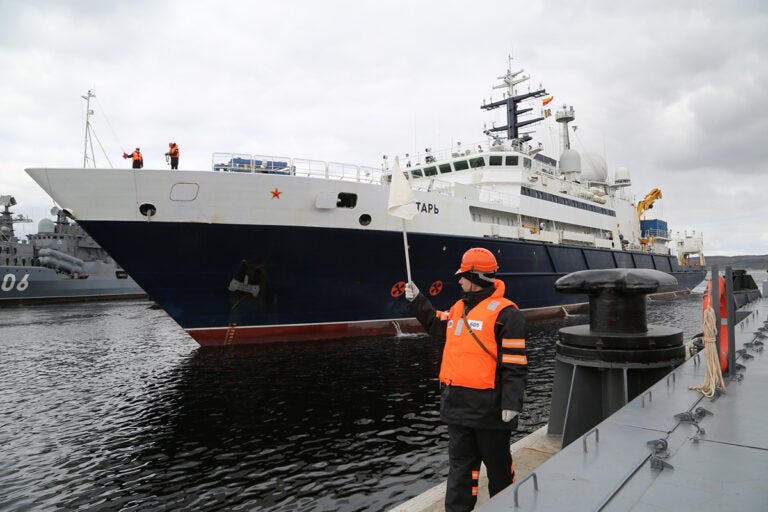
From Moscow’s perspective, seabed infrastructure represents a strategic pressure point. In a crisis, disruption need not be permanent; temporary cable outages, unexplained faults, or ambiguous damage can have significant political and economic effects without crossing explicit escalation thresholds.
Any Bastion that fails to incorporate seabed security into its core operational framework will remain incomplete.
What Actually Worries Moscow
The Atlantic Bastion poses a genuine destabilising threat to Russia only if three specific conditions are met.
First, it gains depth. Extension eastward into the Barents Sea and westward into the deep Atlantic threatens surge logic rather than simply monitoring transit routes.
Second, it integrates punishment. Russia’s deterrence calculus is shaped by fear of conventional precision strike, not sensors. Maritime strike platforms, loitering undersea effects, and naval mining held in reserve change the equation.
Third, it survives escalation. Russia assumes Western systems will withdraw under legal, political, or commercial pressure during a crisis. A Bastion that remains active through the grey-to-war transition undermines that assumption.
At that stage, the Bastion transitions from a sensor network to an escalation management challenge for Russia.
What the UK and NATO Are Already Doing
This assessment should not be interpreted as an argument for inaction. The Atlantic Bastion did not develop in isolation and is not intended to function independently. It reflects a broader, coordinated shift in UK and NATO approaches to undersea control, escalation management, and resilience in the North Atlantic.
At the UK level, the Bastion sits alongside three important developments:
First, the Royal Navy is reestablishing undersea awareness as a continuous peacetime activity rather than relying solely on surge responses. Persistent ASW patrols, P-8 operations from Lossiemouth, renewed SSN focus on the North Atlantic, and the early integration of uncrewed systems collectively indicate a posture intended to shape adversary behaviour well before the onset of crisis.
Second, protecting seabed infrastructure has become an explicit military responsibility. UK–Norway agreements on pipeline and cable security, enhanced monitoring of suspicious vessels, and a more direct connection between ASW, maritime security, and economic resilience all reflect an understanding that undersea warfare now encompasses a broader range of activities beyond traditional torpedo engagements.
Third, the Royal Navy is integrating sensing capabilities with command functions. The transition to shared digital infrastructure, the creation of a unified maritime operational picture, and the acceleration of decision support processes are intended not only to improve efficiency but also to ensure that detection leads to timely action at the political level, not merely at the tactical level.
At the NATO level, the picture is broader still.
The Alliance has decisively reclassified the Atlantic as a contested theatre rather than a secure rear area. Initiatives such as the Digital Ocean project, renewed NATO ASW barrier efforts, and the rapid integration of national sensor networks into a unified operational picture all support this shift. Exercises like Baltic Sentry and Atlantic-focused ASW serials are intentionally visible, serving both as demonstrations of capability and as strategic signals.
Importantly, NATO is revisiting the concept of deterrence by punishment at sea. Maritime strike capabilities, long-range fires, and the integration of non-US assets into Atlantic planning are now openly discussed. These elements are essential to maintaining credibility in an environment where Russian escalation logic differs fundamentally from NATO's.
While these measures do not guarantee success, they indicate that the Atlantic Bastion should be regarded as an initial step rather than a completed defensive architecture.
A Shifting Atlantic Context
The Atlantic Bastion is emerging at a moment of wider strategic flux. Recent US actions beyond the European theatre, and renewed attention on Greenland’s strategic position, underline that the Atlantic is no longer governed solely by alliance routine or predictable escalation norms. From Moscow’s perspective, these signals matter less for their specifics than for what they suggest about Western cohesion, restraint, and political bandwidth.
This does not weaken the case for the Bastion. It strengthens it. In a world where great power behaviour is increasingly transactional and geographically assertive, undersea deterrence becomes one of the few domains where stability can be quietly maintained without constant political theatre. The more visible and volatile surface politics become, the more important it is that the Atlantic beneath remains governed by clarity, persistence, and credible consequence.
Russian Naval Growth: How Moscow Intends to Counter NATO in the 2026–2035 Window
A common Western assumption is that Russia’s navy is a declining force, constrained by sanctions, shipyard bottlenecks, and the demands of a prolonged land war. That assessment is only partially correct, and dangerously incomplete when applied to the undersea domain.
Russia does not need a large navy to counter NATO. It needs a focused one.
A Submarine-Centric Growth Model
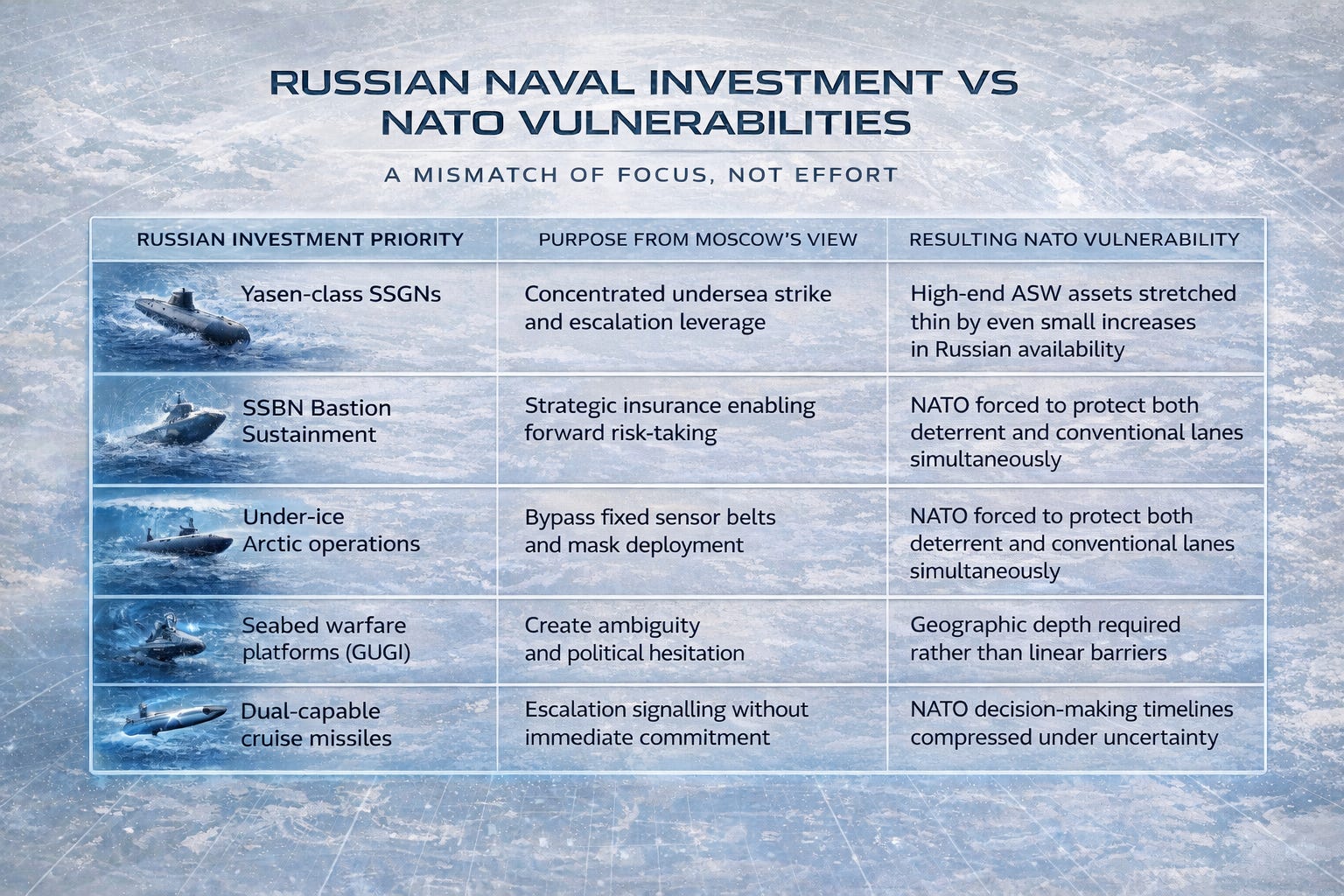
Russian naval investment over the next decade is overwhelmingly biased toward submarines, seabed systems, and long-range strike rather than surface fleet parity. This is not a temporary expedient. It is a deliberate structural choice.
Key trends are already visible:
Continued Yasen-class production
Despite delays, Russia remains committed to fielding additional Yasen-M SSGNs through the early 2030s. These boats are central to Russia’s Atlantic strategy because they combine stealth, endurance, and conventional and nuclear strike in a single platform. Even small increases in Yasen numbers disproportionately increase NATO’s ASW burden.
Sustainment of the SSBN force
Borei-class SSBNs remain protected assets, but their presence shapes Russian risk tolerance elsewhere. As long as the SSBN bastion is credible, Russia can accept greater risk with attack submarines operating forward.
Investment in specialised undersea platforms
Russia’s Main Directorate of Deep-Sea Research continues to receive priority funding. This includes seabed mapping ships, mini-submarines, and deep-diving platforms designed not for combat, but for infrastructure interference, sensor exploitation, and ambiguity creation.
Russia’s growth model is therefore not linear fleet expansion. It is selective amplification of the systems that stress NATO the most.
Quantity Is Less Important Than Disruption
From Moscow’s perspective, NATO’s vulnerability lies not in platform numbers, but in coordination, endurance, and political cohesion.
Russian naval planning assumes that:
NATO ASW forces are finite and high value
Western publics are sensitive to economic disruption
Escalation thresholds at sea remain politically ambiguous
Even a modest increase in Russian submarine availability can force NATO into difficult trade-offs: escorting transatlantic shipping, protecting undersea infrastructure, tracking SSNs, and maintaining SSBN protection simultaneously.
This is why Russian planners focus on dilemma creation, not sea control.
Arctic Enablement as Force Multiplier
One of the least appreciated aspects of Russian naval growth is how Arctic capability acts as a multiplier rather than a separate theatre. Under-ice navigation, Arctic basing, and polar logistics allow Russia to:
Mask submarine deployment patterns
Bypass predictable sensor belts
Force NATO to defend depth rather than lines
This is not about dominating the Arctic. It is about using it to unbalance Atlantic defence planning. If the Atlantic Bastion remains geographically shallow, Russian naval growth does not need to be large to be effective.
The Strike Problem
Russian naval growth is inseparable from its emphasis on strike. Submarines are not viewed primarily as hunters. They are viewed as mobile launch platforms.
The continued deployment of long-range cruise missiles, including dual-capable systems, means that Russian submarines threaten not only shipping and military targets, but also political decision-making timelines. The mere possibility of conventional or nuclear strike from the Atlantic shapes escalation dynamics long before weapons are fired.
This is why Russia judges deterrence less by sensor density and more by whether NATO can impose reciprocal cost.
What This Means for the Atlantic Bastion
The uncomfortable implication is this:
The Atlantic Bastion will face increasing pressure over time, not decreasing. Russian naval growth does not aim to overwhelm the Bastion.
It aims to:
Stretch it
Saturate it
Outlast it politically
If NATO treats Bastion as a static defensive architecture, Russian adaptation will steadily erode its deterrent value.
If, however, Bastion evolves alongside this threat, expanding geographically, integrating punishment, and remaining active through escalation, Russian naval growth becomes a liability rather than an advantage.
That is the strategic contest now unfolding under the Atlantic.
The Russian Bottom Line and Why It Matters
From Moscow’s current perspective, the Atlantic Bastion is considered credible but not decisive. It complicates Russian planning processes without eliminating operational options. The Bastion serves more as a signal of intent than as an enforcer of outcomes. Russia’s objective is not to defeat the Bastion, but to withstand its effects long enough to generate strategic dilemmas in other areas.
This dynamic reflects the inherent challenges of maritime deterrence.
The effectiveness of the Atlantic Bastion should not be measured solely by its ability to prevent submarine incursions; such a metric is insufficient.
Its primary purpose is to compel Russian decision-making earlier, more rapidly, and under less favourable conditions. The Bastion aims to compress operational timelines, limit escalation options, and increase the risks associated with pre-conflict manoeuvring, rather than rendering such actions impossible.
This issue extends beyond anti-submarine warfare considerations.
It is a command. The Atlantic should no longer be viewed as a defensive moat, but rather as a domain for strategic messaging, fought below the surface but decided above it. The Atlantic is no longer a moat. It is a message space. The credibility of the Bastion depends on mutual understanding of its strategic message by both parties.
Further Reading and Context
Core analysis and doctrine
Royal United Services Institute
The Atlantic Bastion (Kaushal & Black, 2025)
The foundational analytical paper underpins much of the public Bastion debate. Particularly strong on deterrence by denial versus punishment and Russian surge logic.Centre for Naval Analyses
Russian Strategy for Escalation Management
Essential reading for understanding how Moscow thinks about signalling, nuclear thresholds, and maritime escalation control.UK Ministry of Defence
Strategic Defence Review 2025
The political and strategic context for Atlantic Bastion includes an explicit linkage to seabed security and deterrence posture.
Russian naval thinking and capabilities
Michael Kofman et al.
Russian Military Strategy: Core Tenets and Operational Concepts
A sober examination of how the Russian armed forces think about war termination, time, and attrition rather than decisive victory.Barents Observer
Coverage of Northern Fleet exercises and under-ice submarine operations
Particularly useful for tracking real-world behaviour rather than stated intent.U.S. Naval Institute
Analysis of Yasen-class SSGNs and Russian undersea strike doctrine
Helpful for understanding why conventional precision strike matters so much to Russian deterrence calculus.
Undersea infrastructure and grey-zone activity
Atlantic Council
Reports on subsea cable vulnerability and hybrid maritime threats
Strong on the economic and political implications of undersea disruption.NATO
Digital Ocean initiative and maritime situational awareness updates
Signals how NATO is quietly rebuilding Atlantic-wide undersea coherence.European Union
Subsea cable security and maritime resilience initiatives
Useful context for the civilian–military convergence now shaping seabed protection.
Related Future Navy work
Readers interested in the themes explored here may also want to look at:
The Digital Ocean: Securing the Invisible Fleet
AI Shipmate: Command at Machine Speed
The Atlantic Is No Longer a Moat
Seabed Warfare and the Economics of Deterrence
Very interesting.
Excellent analysis. Thank you.