

When the Chief of the Defence Staff calls for a “whole-of-society effort” to deter Russia, he is not issuing a warning about the future. He is describing the present.
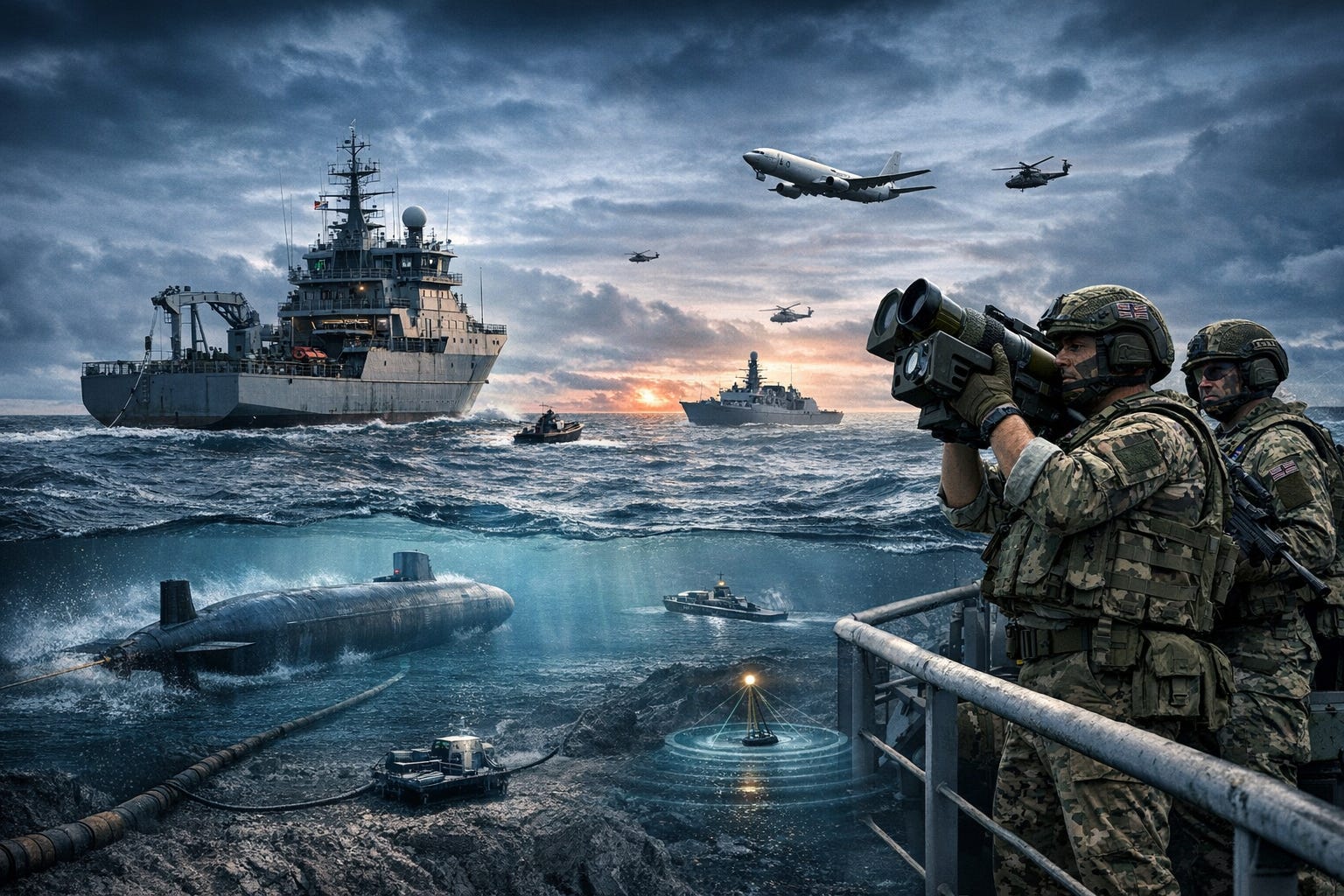
The UK’s national power now rests on infrastructure that lies largely unseen: undersea data cables, energy interconnectors, pipelines, and seabed systems that enable economic life, military command, and alliance cohesion. These systems are already being surveilled, mapped, and interfered with below the threshold of war.
This is not an abstract risk. It is an active contest — and it is happening now, not in the mid-2030s.
For the next two to three years, the Royal Navy must secure the undersea domain without operational mass from Type 26 or Type 31. That gap is real, measurable, and unavoidable. The question for leadership is not whether this is uncomfortable. It is whether we act decisively to manage it. That gap cannot be wished away — but it can be managed.
This article sets out a Future Navy proposal to do exactly that.
The reality we must plan against — not the one we prefer
Between now and the late-2020s, the UK’s ASW posture rests on a narrow base:
Type 23 carries almost the entire frontline ASW burden, increasingly stretched and ageing.
Type 45 can escort, protect and command — but it is not an ASW hunter.
P-8 Poseidon and Merlin HM2 are world-class, but scarce and in constant demand.
Type 26 and Type 31 will not arrive in sufficient numbers to close the gap.
This is not a failure of ambition. It is a consequence of time.
What would be a failure of leadership is pretending this gap does not exist.
The answer is not to dilute high-end ASW forces further. It is to build mass, persistence and visibility alongside them — now.
A Future Navy proposition: the Rapid ASW Fleet
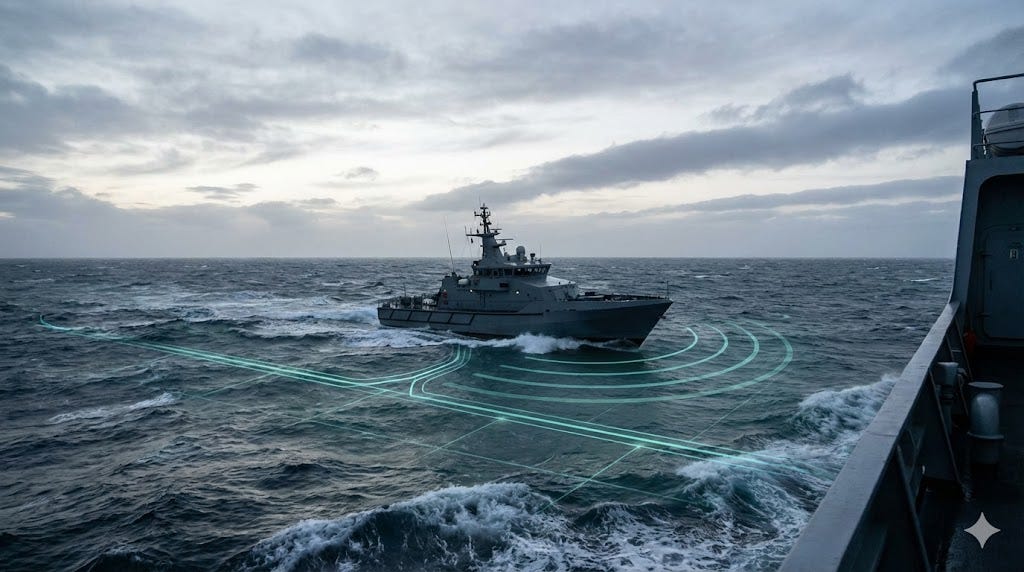
The Rapid ASW Fleet is a deliberate, time-bound response to this gap.
It does not attempt to replace Type 26.
It does not pretend commercial hulls are frigates.
It does not chase technological perfection.
Instead, it focuses on four things that matter immediately:
1. Persistent presence
Continuous occupation of key seabed routes, landing zones and choke points.
2. Undersea visibility
Using towed passive arrays, seabed sensors and autonomous systems to make covert activity observable.
3. Rapid cueing of high-end assets
Enabling Type 23, P-8 Poseidon, Merlin HM2 and allied forces to act decisively.
4. Deterrence through attribution and mass
Making interference visible, attributable and politically costly.
This is not a warfighting fleet. It is a persistent, commercially enabled undersea tripwire force that detects, attributes, and cues — buying time and space until the future fleet arrives.
This is not theoretical — the UK is already doing it.
Crucially, this proposal does not start from a blank sheet. The Royal Navy and UK industry have already demonstrated the model:
RFA Proteus — a converted offshore support vessel, acquired and operational within a year, now conducting seabed surveillance and undersea monitoring.
HMS Stirling Castle — a commercial hull rapidly converted into a mothership for autonomous systems, now a commissioned warship.
Project CABOT and NATO Digital Ocean initiatives — linking uncrewed sensors, crewed platforms and shore-based analysis.
UK SME-led USV trials — proving that small manned ships and unmanned systems can be integrated at speed.
This proposal connects these strands into a coherent, executable force concept.
The platforms: commercial hulls, adapted fast
The backbone of the Rapid ASW Fleet is converted commercial offshore vessels:
Offshore support vessels
Survey ships
Large patrol hulls
These ships already offer:
North Atlantic sea-keeping
Endurance measured in weeks.
Deck space for sensors, USVs and containers
A mature UK industrial base for conversion and sustainment
They are not acoustically pristine — and that is acknowledged. But operating within defined speed and machinery envelopes, they can deploy towed passive arrays, seabed sensors and autonomous vehicles effectively enough to act as persistent acoustic pickets.
The aim is coverage, not stealth.
Thin ships, thick shore — where the real advantage lies
The decisive advantage of this fleet sits ashore. Rather than placing scarce acoustic analysts on every hull, the Rapid ASW Fleet is built around:
Edge processing at sea
Secure, prioritised data transmission
Centralised shore-based fusion centres
This aligns with NATO’s emerging underwater mission networks and reflects reality: expertise is finite, sensors are not. This is how scarce skills are scaled up to operational levels.This model enables:
Pattern-of-life analysis
Long-term anomaly detection
Evidence building for attribution
Rapid cueing of P-8, Merlin, Type 23 and allied assets
Grey-zone competition is not won by perfect detections — it is won by persistent observation and decision advantage.
Protection without pretending — the Royal Marines’ role
These ships are not designed to fight peer navies — but they must be protected.
Here, history matters.
In 1982, the UK rapidly adapted merchant shipping to sustain operations in contested waters. Protection was pragmatic, layered and proportional.
The same logic applies now.
Embedded Royal Marine detachments provide:
Close-range ship protection
Deterrence against harassment and interference
Confidence to operate forward
Equipped with:
Man-portable air defence (e.g. Starstreak / Martlet)
Lightweight remote weapon stations
Small-boat defence and counter-drone capability
This is not escalation. It is a credible presence.
What this force does — and what it does not
Clarity is essential. The Rapid ASW Fleet does:
Maintain continuous undersea awareness.
Monitor cables and seabed infrastructure.
Detect and classify anomalous activity.
Cue high-end ASW forces
Free scarce escorts for tasks only they can perform.
Support attribution and political decision-making
It does not:
Replace Type 26
Conduct an independent submarine prosecution.
Operate unprotected in high-intensity conflict.
Protection is layered. Escort is available if required. Visibility itself is a deterrent. Honesty here is what gives the concept credibility.
This is what “whole-of-society” actually looks like
This fleet is not just naval; it deliberately mobilises:
UK offshore industry — hulls, yards, crews, sustainment
UK SMEs — sensors, autonomy, data fusion
Reserves and RFA — expanding the meaning of service
Telecoms, finance and energy sectors — defining priority routes and resilience thresholds
Insurers and regulators — making interference economically visible
This is deterrence built into national function — not confined to the fleet.
Leadership means acting before the fleet arrives.
The UK faces a two-to-three-year gap in credible, persistent undersea security before Type 26 and Type 31 enter service in meaningful numbers. During that period, the foundations of national power, data, energy, deterrence and alliance credibility, remain exposed to persistent grey-zone activity.
This risk cannot be mitigated solely by existing high-end assets.
A Rapid ASW Fleet, built around converted commercial hulls, autonomous sensors, shore-based analysis and embedded force protection, can be fielded at speed using UK industry and existing technology. It would deliver immediate persistence, detection and attribution, while freeing scarce escorts for tasks only they can perform.
This is not a substitute for the future fleet. It is a bridge to it.