

The Royal Navy’s Atlantic Bastion is emerging as a key idea in modern maritime defence. It is a layered network of sensors, autonomous systems, and crewed platforms designed to detect and constrain Russian submarines before they reach the wider Atlantic.
It is a serious answer to a serious problem. Yet as we strengthen this undersea defence, we must consider a different kind of fleet already manoeuvring above.
The Bastion as Designed
The concept is clear enough. A distributed system of surveillance and anti-submarine warfare capabilities, combining uncrewed platforms, acoustic sensing, and high-end assets like the Royal Navy Type 26 frigates. Its purpose is deterrence by denial: to make it difficult, risky, and unattractive for adversary submarines to operate unseen in the North Atlantic.
Recent analysis notes the Bastion is intended to form a persistent detection network, combining autonomous systems with traditional ASW forces to constrain Russian freedom of manoeuvre in critical waters. Necessary, but not sufficient.
However, as we examine its limits, it becomes clear that more is needed.
The Fleet We Don’t See
Alongside Russia’s submarine force sits another, less visible system of maritime power.
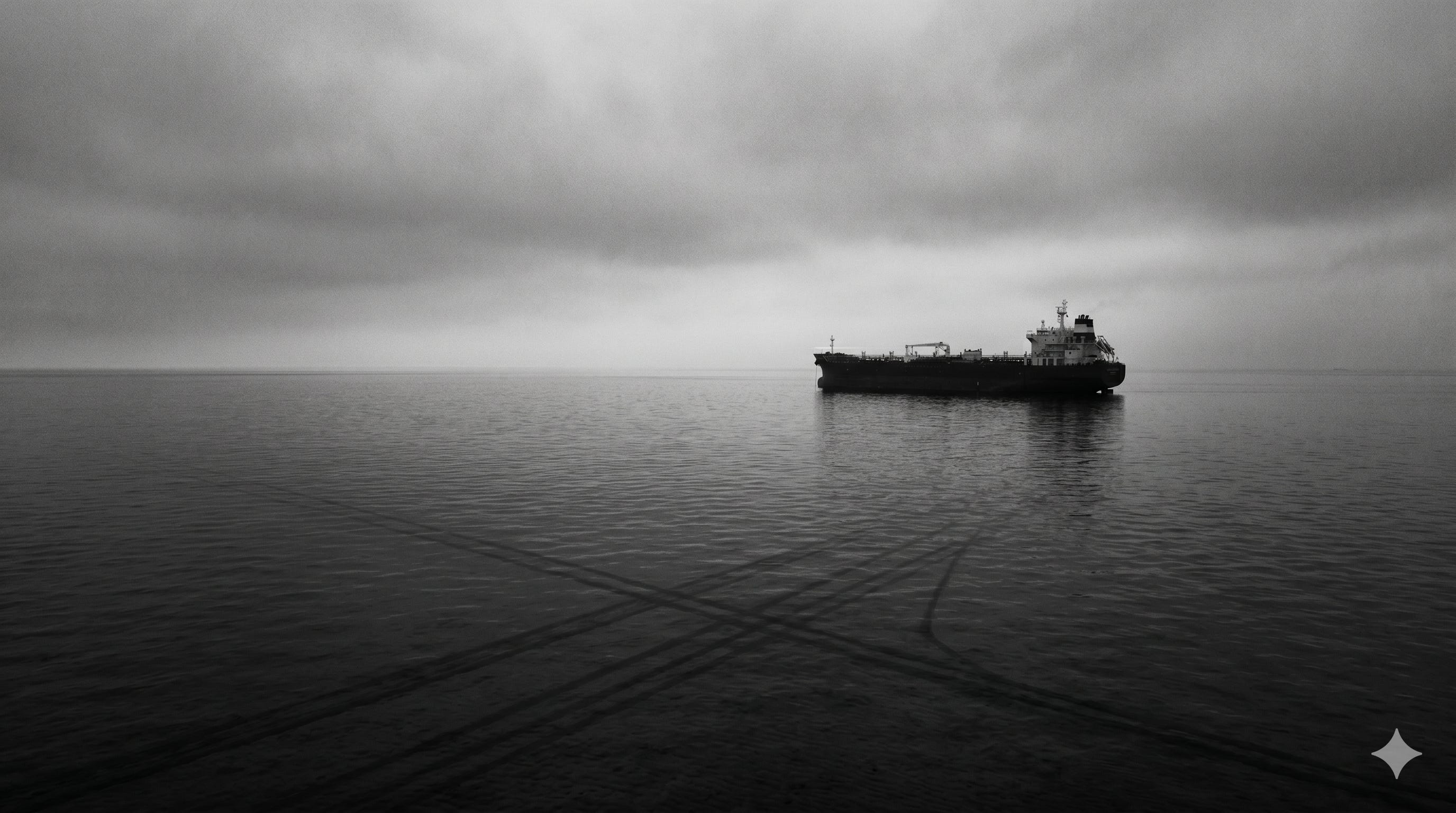
A “shadow fleet” of commercial vessels operates through opaque ownership structures, flags of convenience, and complicated legal arrangements. Tankers, cargo ships, and support vessels move through global trade routes with limited transparency and ambiguous accountability.
These ships are not warships. But they offer something equally valuable: presence without attribution.
They can loiter, observe, and operate near critical infrastructure without triggering thresholds that normally justify a military response. This subtle but profound shift requires attention.
The Gap in the Bastion
The Atlantic Bastion is designed to detect submarines. But the most difficult challenge in the maritime domain today is not detection. The challenge is interpretation.
A submarine detected in the GIUK gap is a military problem. A commercial vessel operating slowly over a subsea cable route is something else entirely.
It may be conducting legitimate activity.
It may be mapping.
It may be signalling.
Or it may be doing nothing.
The difficulty is not seeing it but proving intent. The Bastion, as currently framed, encounters its limits. While advanced, it remains bound by political realities, pointing to necessary evolution.
From ASW Barrier to Maritime Ecosystem
These points indicate a wider shift in how we think about naval defence. The Cold War was a platform-versus-platform model. Submarine against frigate. Detection against evasion. The emerging model is different. Now, the paradigm shifts: the system-versus-ecosystem framework becomes the framework for maritime security.
The Atlantic Bastion already hints at this by combining sensors, autonomy, and crewed platforms into a single operational construct. To be fully effective, it must go beyond the purely military layer.
It must incorporate:
Commercial shipping data
Ownership and registry analysis
Pattern-of-life monitoring
Persistent surveillance above and below the surface
Therefore, the Bastion must evolve beyond an anti-submarine barrier to become a dynamic maritime intelligence system.
The Role of Data and AI
This evolution marks the true transformation in maritime defence. A shadow fleet cannot be countered by more ships alone. It requires:
Correlation across thousands of vessel movements
Detection of anomalous behaviour over time
Integration of civilian and military data sources
The technology exists to do this. Current naval architectures increasingly fuse large volumes of battlespace information into a single operational picture. The challenge is not technical. Therefore, the biggest hurdles are not in technology but in organisation.
Who owns the data?
Who interprets it?
Decisions become especially complex when the signal remains ambiguous, demanding cohesive action.
Deterrence in the Grey Zone
The Atlantic Bastion is built around deterrence by denial. Meanwhile, the grey fleet navigates a space where denial is elusive, and attribution is deliberately murky.
This suggests the need to complement denial with something else:
Regulatory systems that define unacceptable behaviour
Alliances that enable shared surveillance and reaction
And, where necessary, the credible ability to impose cost
Not every action justifies a military response. Yet ignoring ambiguous behaviours could invite greater risks in the long run.
A Wider Battlespace
It becomes clear that the maritime domain is expanding. It is no longer determined exclusively by:
Warships
Submarines
And naval engagements
It now includes:
Data flows
Infrastructure
Commercial actors
And ambiguous behaviours below the threshold of conflict
The Atlantic Bastion sits at the centre of this change. To remain effective at this centre, the Bastion itself must adapt to the changing environment.
Conclusion
The Royal Navy is right to focus on the undersea fight. Submarines remain one of the most dangerous and strategically significant threats in the North Atlantic. But the next challenge may not come from below the surface.
It may arrive quietly, under a commercial flag, operating within the rules, and just beyond the point where those rules can be easily enforced.
If the Atlantic Bastion is to succeed, it must be transformed into an active defence that anticipates threats above and below the surface. The time to act is now—adapt, innovate, and lead to secure the maritime domain. The Bastion must not just observe but actively interpret, decide, and respond to threats. Proactive action—not just awareness—must be the standard.
In today’s maritime battlespace, recognising threats is insufficient. We must act on what we understand. Understanding alone is not enough—action must follow. Seize this moment to adapt, drive innovation, and take a leadership role in shaping maritime defence.
Further Reading
Royal United Services Institute – The Atlantic Bastion
The most detailed open-source assessment of the concept. Highlights both its strengths and the risk of defining the problem too narrowly around submarine detection alone.Foreign Policy Research Institute – Atlantic Bastion: The Future of Anti-Submarine Warfare
Explores the layered sensor network, AI-enabled detection, and the scale of the Russian undersea challenge that Bastion is designed to address.Royal Navy – Strategic Defence Review 2025
Sets the direction for a hybrid fleet and North Atlantic focus, but leaves open questions around grey-zone activity and infrastructure protection.North Atlantic Treaty Organization – Maritime security and critical undersea infrastructure initiatives
Increasingly central to alliance thinking as seabed warfare and cable protection move into the foreground.International Maritime Organization – Maritime regulation and governance
Provides the legal context that makes grey-zone activity at sea difficult to challenge, even when behaviour appears suspicious.Maritime autonomy and sensing developments
A snapshot of how AI, machine vision, and uncrewed systems are expanding maritime awareness beyond traditional radar and AIS.