

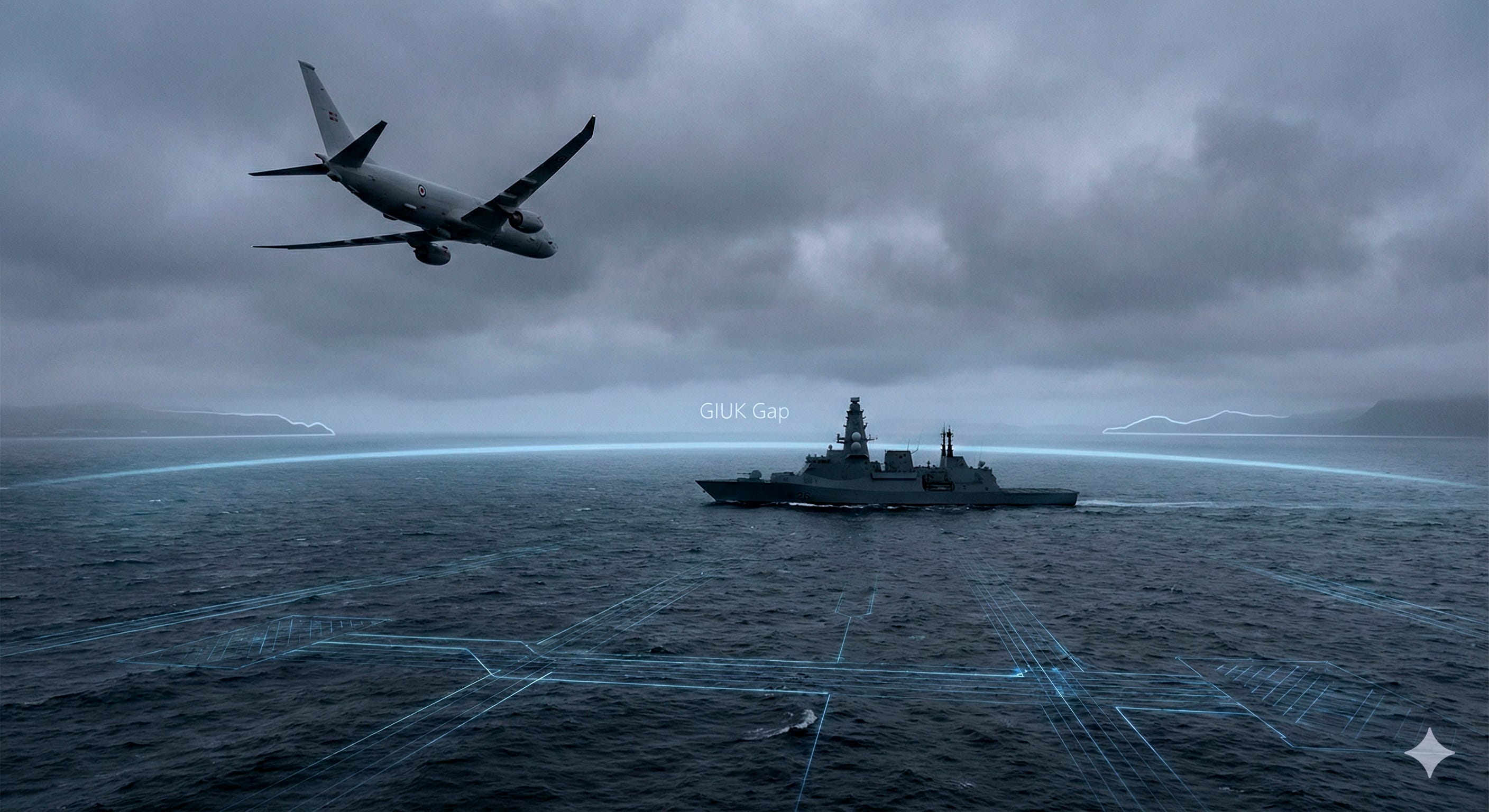
Most people probably missed it. Buried under election noise, competing global crises, and the usual transatlantic commentary, the United States published its new National Security Strategy (NSS), which marks the most consequential shift in American defence posture in over a decade.
Its implications for Europe, and for the Royal Navy in particular, are profound.
The NSS does not announce a withdrawal, nor does it reduce America’s commitment to NATO or European stability. Instead, it reorders the hierarchy of U.S. strategic effort. It tells us, clearly and unmistakably, where American military attention will be concentrated in the decade ahead, and where it will not.
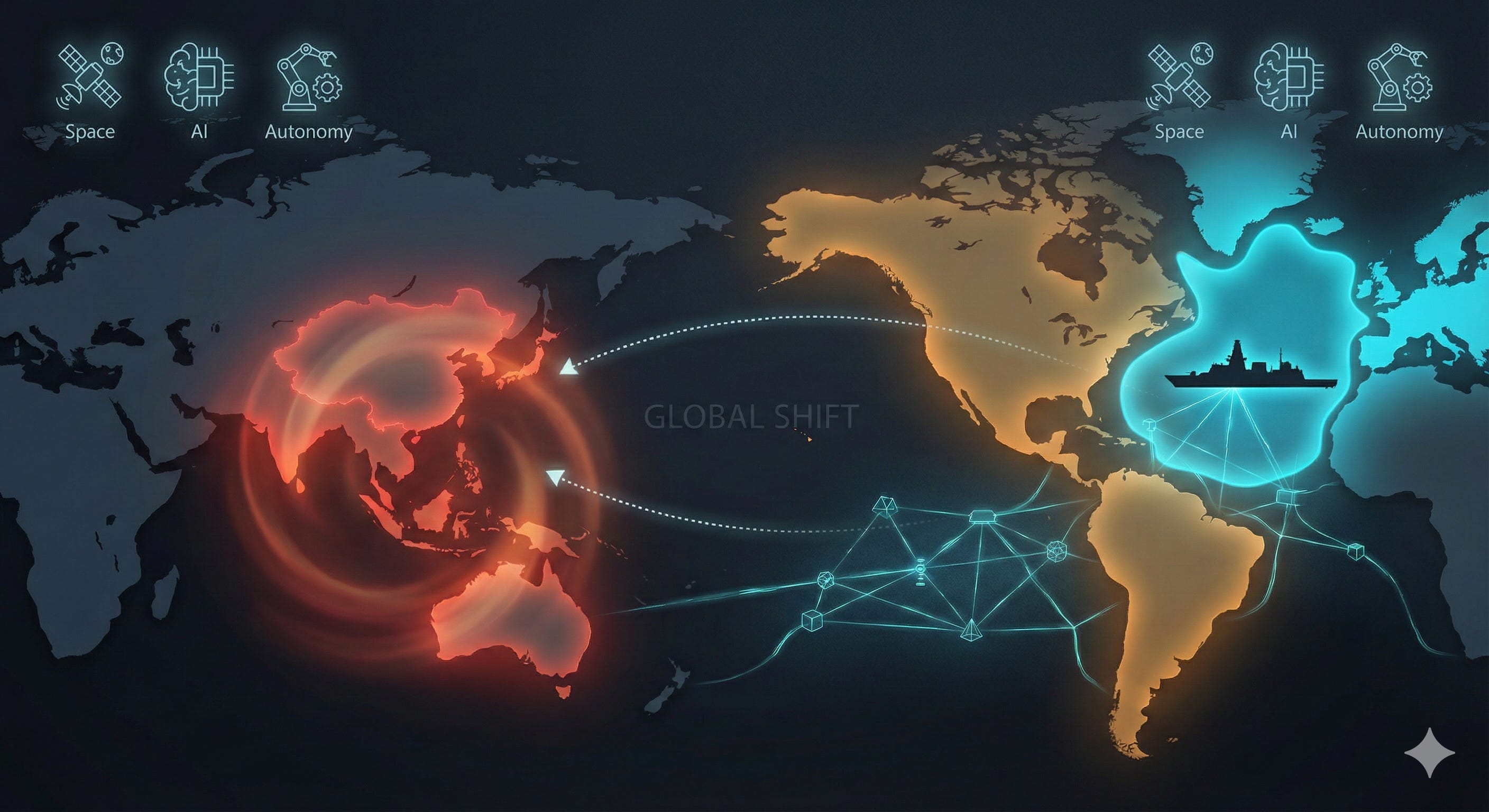
The immediate result is simple:
The North Atlantic is becoming a European responsibility.
And Europe is only just beginning to adjust to that reality.
A U.S. Strategy Built Around New Domains
The new NSS represents a decisive rebalancing of American military focus. Four priorities now dominate:
1. The Indo-Pacific
Washington sees the First Island Chain and Taiwan as the defining military contest of the coming decade. U.S. naval mass — destroyers, carriers, submarines — will inevitably flow toward the western Pacific.
2. The Western Hemisphere
A sharpened Monroe Doctrine, now reinforced by what some analysts are calling the “Trump Corollary,” places new emphasis on maritime control, border security, and stability in the Caribbean and Gulf of Mexico.
3. High-End Strategic Domains
The NSS names three explicitly:
Undersea warfare — where the U.S. seeks to retain or widen its advantage
Space power — the foundation of modern deterrence, targeting, and communications
AI, quantum and autonomy — the technologies that will define the tempo of future conflict
These domains will consume enormous American investment, focus and force availability.
4. Europe as a Region That Must Lead Itself
Europe remains important. NATO remains vital. But the NSS leaves no ambiguity:
Europe must generate its own deterrent mass in the North Atlantic and its surrounding seas.
This is not abandonment. It is a domain reallocation, a recognition that American capacity cannot stretch endlessly across every theatre. When the U.S. prioritises Indo-Pacific deterrence and Western Hemisphere stability, something has to give.
What gives is the assumption that a U.S. carrier group, a U.S. destroyer squadron, or a constant U.S. ASW presence will always be available in European waters.
That era has ended, and with that, the strategic centre of gravity for Europe begins to move.
NATO’s Digital Ocean: The New Battlespace
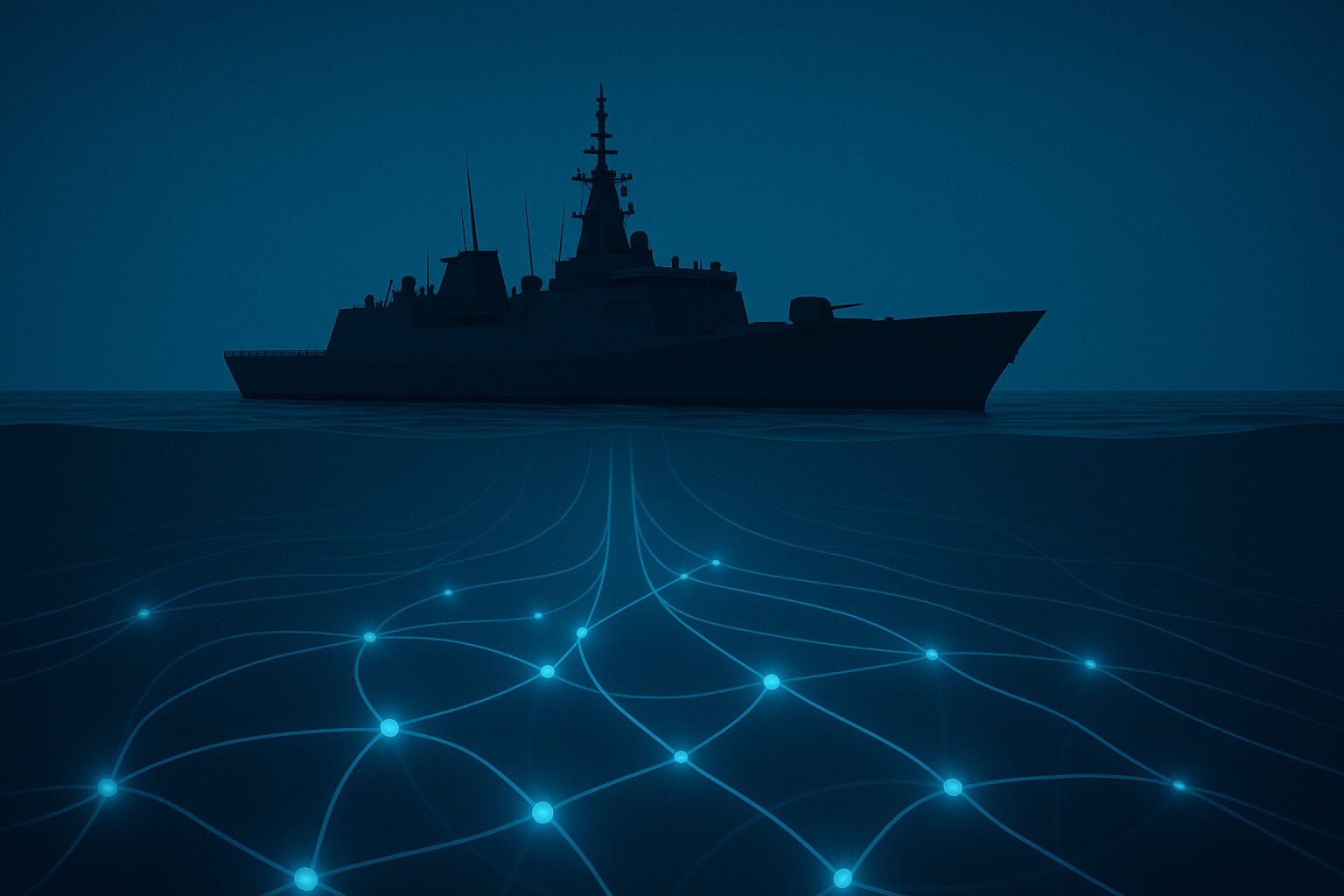
While Washington’s NSS focuses on domains, NATO has been quietly reshaping its own vision of the undersea battlespace.
The Digital Ocean is no longer a concept; it is becoming a programme of record.
Its logic is as stark as it is compelling:
The seabed, not just the sea surface, is now a critical infrastructure zone.
Russian submarines are quieter, more numerous, and more active than at any time since the Cold War.
Europe’s reliance on data cables, offshore energy, and maritime trade is existential.
No number of crewed ships can watch the North Atlantic alone.
That pushes NATO toward a different architecture:
Persistent seabed sensors
Long-endurance autonomous UUVs
Distributed USVs and UAVs
AI-enabled acoustic and oceanographic processing
Frigates acting as data-fusion nodes rather than isolated platforms
It is a shift from platform-centric warfighting to a network-centric undersea deterrent.
For the Royal Navy, this transformation is uniquely well timed:
The Type 26, with its quiet propulsion and flexible mission bay, is ideally suited as a Digital Ocean command node.
The Type 31, with its open architecture and global presence role, becomes the scalable surface partner for autonomous systems.
The Patrick Blackett, Rattler, NavyX ecosystem and the SDRs’ digital commitments give the UK a technological advantage few European navies possess.
But the Digital Ocean needs geography as much as technology, and this is where the next shift arrives.
The UK–Norway Pact: The New Northern Core
The joint announcement that the UK and Norway will operate a combined fleet of Type 26 ASW frigates may be the single most strategically important naval commitment in Europe this decade.
It is precisely the kind of regional burden-sharing the U.S. NSS calls for. And it forms the nucleus of what can only be described as a Northern Atlantic Bastion.
Why Norway?
It sits on Russia’s maritime doorstep.
It controls the northern access routes to the Atlantic.
It operates P-8 Poseidon aircraft and advanced UUVs.
It has deep experience in the GIUK Gap.
It is already a leader in undersea sensing and seabed surveillance.
Why the UK?
It anchors the southern gate of the GIUK Gap.
It remains Europe’s most capable ASW navy.
It operates P-8s, SSNs, and the continuous at-sea deterrent.
It has the only European ship class (Type 26) designed from the outset for future integration with Digital Ocean.
Together, these two nations form a natural ASW coalition, one that complements NATO rather than complicates it. The combined T26 force is not a symbolic gesture. It is a capability that reduces risk for the entire alliance.
It is also the clearest sign yet that Europe is beginning to take responsibility for the theatre; the U.S. is no longer guaranteed to cover every day.
The Emerging Architecture: Europe Builds the Bastion
When these three developments are overlaid — the U.S. shift in domains, NATO’s Digital Ocean, and the UK–Norway pact — a clear architecture emerges.
1. The U.S. leads global deterrence and high-end domain dominance
Indo-Pacific naval mass, space power, undersea superiority, AI-enabled command, and Western Hemisphere stability.
2. Europe secures the North Atlantic
The UK, Norway, Iceland and Denmark form the geographic and operational spine of a northern shield.
3. The Royal Navy acts as an integrator
The RN, more than any other European navy, spans:
Undersea warfare
Carrier strike
Autonomy trials
P-8 operations
SSN deployment
NATO C2 frameworks
4. Type 26 becomes the coalition’s high-end ASW backbone
Quiet, flexible, and designed for both traditional ASW hunting and digital-era undersea integration.
5. Type 31 becomes the mass that fills the escort gap
Presence, patrol, sanctions enforcement, cable protection, and autonomous system hosting.
6. Autonomy becomes the force multiplier
Hull numbers alone cannot secure the North Atlantic.USVs, UUVs, and AI-fused sensor webs are what make the bastion credible. This is Atlantic Bastion — a strategy not declared formally, but emerging organically from U.S. demands, NATO innovation, and UK–Norway cooperation.
What This Means for the Royal Navy
1. The next decade belongs to the North Atlantic
Carrier strike remains valuable, but the heart of the RN’s purpose returns to the GIUK Gap and Norwegian Sea.
2. T26 is no longer a national programme — it is a regional asset
Every T26 hull strengthens not just the UK but the coalition.
3. T31 must be delivered quickly, and in meaningful numbers
Escort mass is now the bottleneck in European security.
4. The RN’s autonomy work must scale
Mission-bay systems, long-endurance UUVs, TEWA evolution, and AI-enabled C2 are decisive advantages.
5. The UK becomes NATO’s lead navy for Digital Ocean integration
The RN blends geography, capability and technical maturity in a way few others can match.
2026: The Year of Delivery
2025 sets the trajectory.
2026 must execute.
Here’s what Europe must deliver:
The first operational steps of the UK–Norway T26 partnership
A Digital Ocean deployment roadmap
A European escort regeneration plan
Accelerated autonomy integration
A realistic carrier group availability model
A shared understanding that U.S. domain shifts require European domain ownership
The Atlantic Bastion is not a slogan. It is the only structure that makes sense in the world that the U.S. NSS has just defined. And the Royal Navy, more than any other European fleet, is positioned to lead it.
Final Thought
The United States has not abandoned Europe; instead, it has shifted its focus and handed over responsibility for the North Atlantic to European nations. The recent pact between the UK and Norway is the first indication that Europe has understood this message. The pressing question now is whether we can act swiftly enough to create the stronghold essential for our security.
Further Reading
UK & Norway: A New North Atlantic Partnership
UK and Norway sign formal naval cooperation agreement — Navy Lookout
(Combined Type 26 ASW fleet and regional burden-sharing)
U.S. National Security Strategy (2025)
National Security Strategy of the United States of America (2025)
(Indo-Pacific priority, Western Hemisphere focus, and shift toward undersea, space, AI and autonomy)
NATO’s Undersea Transformation
Exploiting the Underwater Battlespace — NATO STO / BAE Systems
(Digital Ocean concept, seabed sensors, UUV integration)NATO Digital Ocean initiative overview — Allied Maritime Command
(Persistent sensing and multi-domain fusion across the North Atlantic)
Royal Navy Future Force Design
Type 26 Global Combat Ship — Royal Navy / BAE Systems
(Next-generation ASW capability and mission-bay flexibility)Type 31 (Inspiration-class) Frigate — Royal Navy
(Escort mass, autonomy-ready design, and global presence role)
AI, Autonomy & Command Evolution
AI Won’t Replace the General — The Alan Turing Institute
(AI assurance, human command frameworks, and military decision-support)UK MoD: Defence AI Strategy
(Foundations for AI-enabled maritime operations)
Undersea Infrastructure & Critical Dependencies
The Digital Ocean: Securing Europe’s Seabed Infrastructure — RUSI
(Cable protection, subsea vulnerabilities, grey-zone threats)UK–Europe critical subsea cable mapping — ICPC
(Global cable routes and security risk patterns)